
Apple Bets on ‘Visual Intelligence’ Wearables as It Charts a Distinct AI Strategy
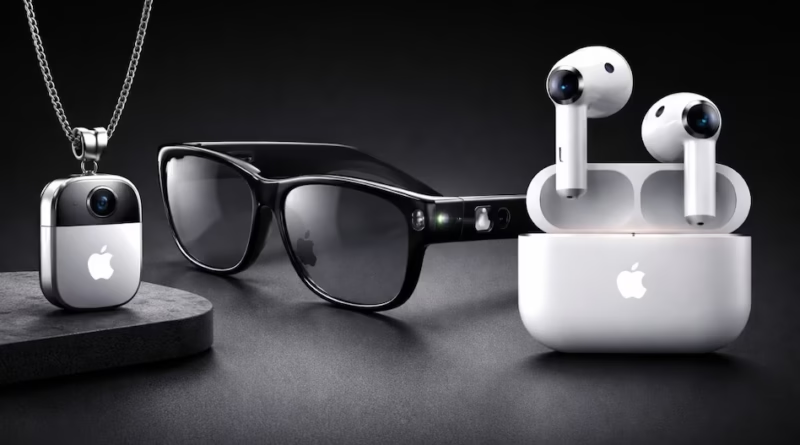
Apple appears to be quietly reshaping its artificial intelligence roadmap—this time with a strong focus on wearable devices powered by what it calls “Visual Intelligence.”
Rather than competing head-on in the race to build the world’s largest AI models, the Cupertino-based company is reportedly concentrating on embedding practical AI tools directly into consumer hardware used by millions every day.
According to reports, CEO Tim Cook has signalled internally that Apple is exploring a new class of AI-driven wearables built around advanced visual perception technology.
Visual Intelligence refers to AI systems capable of interpreting the user’s surroundings and on-screen content, then responding contextually with relevant actions, insights, or answers.
From iPhone Feature to Wearable Ecosystem
The concept first gained prominence with the launch of the iPhone 16 Pro in 2024, when Apple introduced Visual Intelligence capabilities as part of its AI toolkit.
These features enabled users to take a photo or capture a screenshot and ask questions about what they were viewing. Through integrations with OpenAI’s ChatGPT and Google’s reverse image search, the device could analyse images and deliver contextual responses across apps.
Apple has since positioned Visual Intelligence as one of its most user-friendly AI features—allowing faster search, smarter in-app navigation, and more intuitive actions.
The next step, according to reports, is to extend these capabilities beyond smartphones into dedicated AI wearables powered by Apple’s own visual AI models.
The move suggests Apple is aiming to build devices that do more than passively display information. Instead, these wearables could actively “see” and interpret the environment around users, making real-time suggestions or completing tasks based on visual cues.
A Different AI Philosophy
While competitors like Google, OpenAI, and Anthropic are investing heavily in massive data centres and increasingly powerful foundation models, Apple appears to be pursuing a different path.
Rather than chasing scale alone, the company seems intent on becoming the primary distribution channel for AI—delivering curated, high-quality AI experiences through its tightly integrated hardware ecosystem.
With over a billion active devices globally, Apple may be betting that seamless integration and privacy-focused implementation will resonate more with consumers than raw model size.
This strategic divergence could also explain why Apple was notably absent from the recent global AI Impact Summit 2026 in New Delhi, where industry leaders such as Sundar Pichai, Sam Altman, and Dario Amodei participated in high-profile discussions about the future of AI.
A New Product Launch Strategy
Beyond its AI ambitions, Apple is also said to be rethinking how it unveils new products. Instead of its traditional single keynote format, reports suggest the company is planning a three-day announcement sequence culminating in a final in-person event on March 4, 2026.
Journalists are expected to receive hands-on access to upcoming devices, signalling a more staggered and immersive rollout strategy.
What to Expect This March
At least five product launches are anticipated during this cycle. These reportedly include:
- The iPhone 17e
- An updated iPad Air featuring the M4 chip
- A refreshed entry-level iPad
- A new MacBook Air
- Updated MacBook Pro models
If these reports prove accurate, Apple’s upcoming announcements could mark not just a hardware refresh, but a clearer statement of intent: integrating intelligent AI deeply into everyday consumer devices—particularly wearables—while maintaining control over the user experience.
As the global AI race intensifies, Apple appears determined to compete on its own terms—less focused on building the biggest systems, and more focused on making AI feel personal, practical, and seamlessly embedded in daily life.
#Apple #TimCook #ArtificialIntelligence #VisualIntelligence #AIWearables #TechInnovation #iPhone17e #FutureOfAI


