
Caste, Congregations and Politics: Why a Dinner of BJP Legislators Triggered Disproportionate Noise in Uttar Pradesh


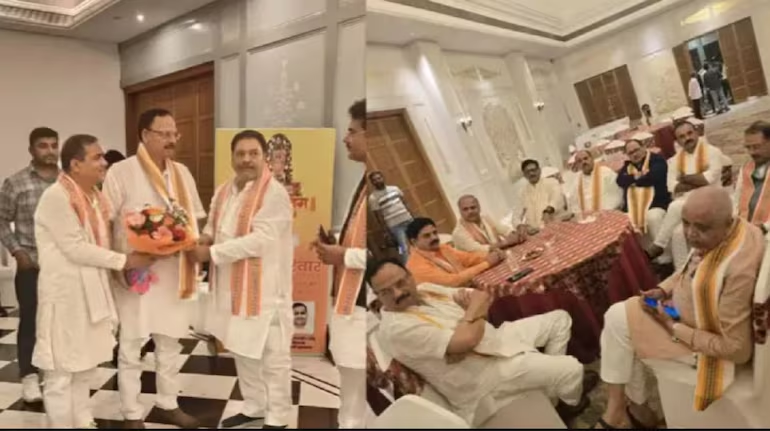
When nearly 40 Bharatiya Janata Party (BJP) MLAs and MLCs — most of them belonging to the Brahmin community — assembled for a late-evening dinner at a colleague’s residence in Lucknow on Tuesday, the gathering instantly became a talking point in Uttar Pradesh’s political corridors.
The timing, coinciding with the ongoing winter session of the Assembly, ensured that what could otherwise have passed as a routine interaction attracted heightened political scrutiny.
Officially, the ruling Bharatiya Janata Party described the meeting as an “informal get-together.”
Unofficially, however, the Opposition rushed to frame it as evidence of internal resentment, alleging that Brahmin legislators within the party were feeling marginalised, humiliated, and compelled to collectively reflect on their future political course.
The dinner began around 7 pm and reportedly continued until midnight. Its significance was amplified by the fact that a similar “informal” gathering of Kshatriya BJP MLAs had taken place earlier during the monsoon session — a detail that raises an obvious question:
If caste identities are deeply embedded in India’s social and political fabric, why does their visible expression suddenly become controversial?
BJP Downplays Caste Angle
Deputy Chief Minister Keshav Prasad Maurya dismissed attempts to view the meeting through a caste lens. “All MLAs are in Lucknow during the Assembly session.
Such meetings are normal and should not be seen from a caste or any other angle,” he said, stressing that informal interactions among legislators are routine during legislative sittings.
The host of the dinner, BJP MLA PN Pathak, echoed this line. He described the gathering as a simple community dinner, explaining that colleagues wished to sit together and enjoy traditional food such as litti-chokha.
According to him, discussions centred on the Special Intensive Revision (SIR) of electoral rolls and development work in their respective constituencies.
“We are satisfied with the performance of the state government,” he maintained.
Underlying Disquiet Cannot Be Ignored
Yet, sources present at the meeting suggest that beneath the surface-level informality, deeper concerns were aired. Allegations of bias, perceived sidelining of Brahmin leaders, and the need for collective assertion reportedly featured in the discussions.
BJP MLA Anil Tripathi, who attended the dinner, publicly acknowledged that conversations extended beyond casual social interaction. “We spoke about social and political issues.
One major concern was that the community, which played a crucial role in the formation of Bharat Toda,y feels humiliated in society,” he said, while insisting that these concerns were social in nature and not a direct criticism of the government.
Another MLA, Ratnakar Mishra, attempted to lighten the narrative, describing the meeting as focused on social issues, es such as inculcating “sanskars” (values).
Among those present were MLAs Ratnakar Mishra, Shalabh Mani Tripathi, Ramesh Mishra, and MLCs Saket Mishra and Umesh Dwivedi. A video of the gathering later surfaced on social media, further fuelling political speculation.
Opposition Seizes the Moment
Despite repeated clarifications from BJP leaders, the Opposition saw an opportunity to sharpen its attack.
Samajwadi Party MLA Amitabh Bajpai claimed the meeting exposed fault lines within the ruling party.
“Leaders of certain castes are getting preferential treatment — bigger vehicles, greater visibility — while Brahmins face action. This meeting was bound to happen,” he remarked.
The Opposition also recalled an earlier episode this year when BJP minister Pratibha Shukla staged a dharna at an Akbarpur police station, alleging disrespect towards Brahmins and accusing party MP Devendra Singh of failing to stand up for the community despite their electoral support.
State minister and Suheldev Bhartiya Samaj Party chief Om Prakash Rajbhar offered a broader sociological observation. “India was once an agrarian society; today it is a caste-based society.
If any caste feels aggrieved, they should meet the Chief Minister or the Prime Minister to resolve the issue,” he said.
Why the Fuss?
The intense reaction to this dinner raises a larger question: when caste consciousness is deeply entrenched across India’s social, political, and electoral systems, why should the congregation of legislators from one community provoke alarm?
Political parties routinely balance caste equations in ticket distribution, governance, and power-sharing.
Leaders mobilise communities during elections, invoke caste identities in campaigns, and rely on caste arithmetic for political survival.
Against this backdrop, a group of legislators from a particular community meeting socially — or even to articulate shared anxieties — is hardly aberrational.
Whether Brahmins, Kshatriyas, or members of any other Hindu community, such congregations reflect a reality that Indian politics has long normalised.
The real issue, perhaps, is not the dinner itself, but the discomfort it causes when the informal becomes visible — reminding everyone of a truth that is usually acknowledged quietly but rarely confronted openly.
#UttarPradeshPolitics #CasteAndPolitics #BJP #AssemblySession #Lucknow #PoliticalGatherings #IndianDemocracy


