
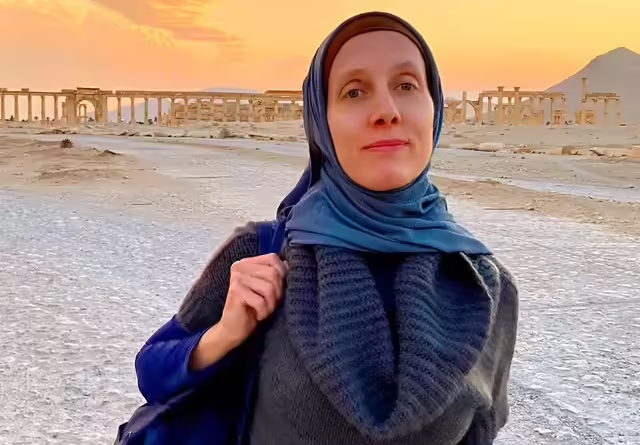
Kidnapping in War Zone: Veteran US Journalist Shelly Kittleson Abducted in Baghdad, Global Outrage Mounts Amid Rising Middle East Tensions
The mysterious abduction of veteran American journalist Shelly Kittleson in the Iraqi capital Baghdad has triggered alarm across the international media community, raising fresh concerns about the safety of reporters working in conflict zones.
Kittleson, a seasoned correspondent known for reporting from some of the world’s most volatile regions, was allegedly kidnapped by armed men in a dramatic daylight operation that has shocked governments and press freedom organisations worldwide.
According to reports, the 49-year-old journalist, originally from Wisconsin and currently based in Rome, was intercepted at a busy intersection near the Baghdad Hotel, close to the heavily fortified Green Zone — the area housing key diplomatic and government institutions.
Surveillance footage circulating on social media reportedly shows armed assailants surrounding her and forcibly pushing her into a waiting vehicle before speeding away, according to the New York Post
According to the Washington PPostKittleson has spent years covering conflicts in Iraq, Afghanistan, and Syria and was working on developments linked to the escalating Middle East crisis when she was abducted.
Her work has appeared in prominent international publications, including Al-Monitor, BBC, Politico,o and Foreign Policy, earning her recognition as a courageous field reporter known for on-ground coverage of war and insurgency.
Dramatic Escape Attempt by Kidnappers
Iraqi security agencies launched an immediate operation after the abduction. Authorities intercepted one vehicle suspected to be linked to the kidnappers after it overturned during a high-speed chase.
One suspect has reportedly been arrested, but Kittleson was not found in the vehicle, indicating she may have been transferred to another car during the escape.
Officials believe the kidnappers may have fled toward Babil province south of Baghdad, prompting heightened security alerts across checkpoints and border routes.
Iraqi intelligence agencies have indicated that she is still believed to be inside Iraq, though her precise location remains unknown.
Possible Role of Iran-Backed Militia
Preliminary investigations suggest the involvement of Kataib Hezbollah, an Iran-aligned militia operating in Iraq, although no organisation has officially claimed responsibility so far.
US officials confirmed that the journalist had received prior warnings regarding credible threats to her safety before she travelled to Iraq, AP news has been quoted as saying.
Some reports indicate that her name may have appeared on a list of targeted individuals, particularly journalists reporting on militia activities or regional tensions linked to the ongoing war involving the United States, Israel, and Iran.
Why This Kidnapping Has Shocked the World
Journalists covering war zones have historically faced extreme risks, including death in crossfire or targeted attacks.
However, kidnapping of experienced international correspondents is relatively rare, particularly in recent years when many militant groups have sought global legitimacy and avoided confrontation with foreign media.
The fact that Kittleson is a senior woman journalist with a long professional record has intensified international concern.
Press freedom organisations have strongly condemned the incident, warning that such attacks undermine independent reporting and restrict the world’s access to ground realities in conflict zones, as per reports from The Washington Post.
Observers note that journalists are often viewed as neutral observers, and even hostile factions have occasionally released captured reporters unharmed in the past.
The present case, therefore, raises serious questions about whether militant groups are becoming more aggressive toward international media amid worsening geopolitical tensions.
Update on the Case
• Iraqi forces have arrested at least one suspect connected to the abduction
• Intelligence agencies suspect involvement of Iran-linked militia elements
• No ransom demand has yet been made public
• The US State Department and Iraqi government are jointly working to secure her safe release
• Global media organisations have called for immediate action to ensure her safety
Wider Context: Journalists in the Line of Fire
War correspondents have frequently lost their lives while covering conflicts in Iraq, Syria, and Afghanistan.
However, deliberate kidnapping of foreign journalists remains an extremely sensitive issue internationally because it is often viewed as an attempt to influence global narratives or exert political pressure.
Experts believe the deteriorating situation in the Middle East — especially the expanding confrontation involving Iran, the United States, and regional actors — has created an increasingly dangerous environment for reporters attempting to document developments on the ground.
Timeline of Events in the Kidnapping of Shelly Kittleson
Veteran conflict reporter: Kittleson is a well-known freelance journalist who has reported extensively from Iraq, Syria, and Afghanistan for international outlets, including Al-Monitor.
Rome-based correspondent: Though based in Italy, she frequently travelled to the Middle East to cover geopolitical tensions and militia activities.
Security concerns: US officials had reportedly warned her of possible threats before her latest visit to Iraq.
Day of Kidnapping – Tuesday (Baghdad)
Morning – Arrival in central Baghdad
Kittleson was in Baghdad to report on escalating tensions linked to regional conflict dynamics.
She was moving through a busy intersection near the Baghdad Hotel, close to the fortified Green Zone.
Daylight abduction caught on camera
- Surveillance footage reportedly shows armed men intercepting her vehicle.
- The attackers forced her into another car and quickly fled the scene.
- Witnesses described a swift and coordinated operation, suggesting prior surveillance.
Immediate security response
- Iraqi authorities launched a rapid search operation.
- A suspected getaway vehicle overturned during a high-speed chase.
- One suspect was detained, but the journalist was not found in the vehicle, indicating she may have been transferred elsewhere.
Within 24 Hours of Abduction, The
- Iraqi Interior Ministry confirmed an active investigation.
- Intelligence sources suggested the involvement of an Iran-linked militia network.
- US State Department officials began coordinating with Iraqi authorities to secure her release.
- No ransom demand or public claim of responsibility was initially issued.
Latest Situation
- Kittleson’s exact location remains unknown.
- Iraqi security forces continue raids and surveillance operations.
- International media organisations and press freedom groups have called for her immediate release.
- The incident has heightened concerns about journalist safety in conflict zones amid worsening Middle East tensions.
Background on Kataib Hezbollah
Formation and Ideology
- Kataib Hezbollah (KH) is a powerful Shia militia group operating in Iraq.
- It was formed around 2007 during the Iraq War and is considered part of the Iran-aligned network of armed factions.
- The group maintains close ties with Iran’s Islamic Revolutionary Guard Corps (IRGC).
Role in Regional Conflict
- KH has been active in insurgency operations against US forces in Iraq.
- It is part of the Popular Mobilization Forces (PMF), an umbrella organisation of militias formed to fight ISIS.
- The group has been accused by Western governments of involvement in rocket attacks and armed operations targeting US interests.
Strategic Influence
- Kataib Hezbollah is believed to have a strong influence in Baghdad and southern Iraq.
- It is considered one of the most powerful Iran-aligned armed factions in the region.
- Analysts often link the group to broader geopolitical tensions between the United States and Iran.
Why Suspicion Falls on the Group
- Some intelligence reports suggest the abduction bears hallmarks of militia-style operations.
- The journalist had reportedly covered militia influence and regional proxy conflicts.
- However, no official claim of responsibility has yet been made, and investigations are ongoing.


