
Lavish Lucknow Mansion Puts Spotlight on Codeine Syrup Scam; ED Probe Reveals Just the “Tip of the Iceberg,” Say Sources
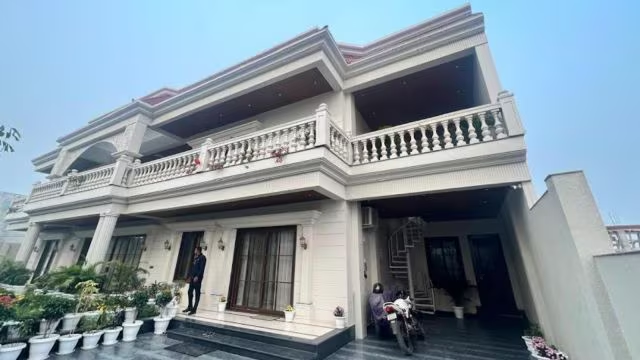
As the Enforcement Directorate (ED) carried out a series of raids on Friday in connection with its money-laundering investigation into an illegal codeine-based cough syrup racket, one location in Lucknow drew particular attention—a palatial mansion allegedly owned by a dismissed police constable, raising uncomfortable questions about unexplained wealth and abuse of public office.
The property belongs to Alok Pratap Singh, a former constable who was arrested in Lucknow more than a week ago.
He is currently lodged in Lucknow jail and is under police remand for 55 hours.
A Mansion That Raised Red Flags
ED officials searched Singh’s sprawling residence in Ahmamau, near the Lucknow–Sultanpur highway, under the jurisdiction of Gold City police station. The search lasted nearly five hours.
While the ED has not officially disclosed the recoveries, sources said several documents and electronic devices were seized, which are now being examined as part of the agency’s money trail analysis.
A senior police officer confirmed that Singh had been living in the house with his family for some time.
Inside the Property
Spread over nearly 7,000 square feet, the two-storey mansion stands just a few kilometres from the upscale Gomti Nagar Extension area.
Painted in light cream, the structure features tall columns, ornate railings, and a wide upper-floor balcony.
The ground floor has tall windows framed by vintage-style lamps opening into a spacious porch.
A covered parking area on one side houses a motorcycle, alongside a spiral staircase leading upstairs. Outside, an ornate gate lined with plants completes the picture of opulence.
According to ED sources, the scale and finish of the property suggest that crores of rupees were spent on its construction.
A government-approved property valuer has been engaged to assess the cost of purchasing the land, constructing the house, and the expenses incurred on its luxurious interiors.
This valuation, sources said, will help determine the quantum of illegal funds allegedly invested in the property. Preliminary estimates suggest that the construction cost alone could be around ₹5 crore, excluding the value of the land.
Arrest and Alleged Role in the Racket
On December 2, the Uttar Pradesh Police Special Task Force (STF) arrested Singh a short distance from his residence.
Police allege that he was an active part of the illegal network and operated two wholesale drug units—one in Uttar Pradesh and another in Jharkhand—in coordination with other members of the syndicate.
His alleged involvement came to light during the interrogation of Amit Kumar Singh alias Amit Tata, who was arrested in Lucknow on November 27.
While the UP Police are probing the criminal aspects of the case, the ED registered its own complaint and initiated a parallel investigation under money laundering laws.
A Long Trail of Controversy
Originally from Chandauli district in Uttar Pradesh, Alok Pratap Singh has a history marred by controversy.
Police records show that his first major brush with crime occurred in 2006, when he was posted with the Special Operations Group (SOG) in Lucknow.
In September that year, he was arrested along with six others—including four policemen—for allegedly looting 4 kg of gold from an employee of a Prayagraj-based businessman.
Following the incident, Singh was dismissed from service. Although he and the other accused were later acquitted due to lack of evidence, he was reinstated in the police force in compliance with the court’s order.
However, after rejoining, fresh allegations of misconduct and dereliction of duty surfaced.
Sources said his name repeatedly appeared in complaints, including allegations of assault. Based on these charges, he was dismissed from service again in 2019.
From Policeman to Power Networks
After his second dismissal, sources said Singh allegedly entered the contract business and was frequently seen in the company of politically connected and influential individuals.
Photographs of him with a former BSP MP also surfaced, adding to speculation about the network he had built over the years.
The Larger Codeine Syrup Network
In February last year, the Uttar Pradesh government constituted a joint investigation team comprising the STF and the Food Safety & Drug Administration (FSDA) to probe allegations that codeine-based cough syrups and narcotic medicines were being illegally stored, sold as intoxicants, and smuggled.
Investigators found that these substances were trafficked within UP and to other states, including Uttarakhand, Bihar, Jharkhand, Assam, and West Bengal, and even smuggled across borders to Bangladesh and Nepal.
So far, 128 FIRs have been registered across 31 districts in Uttar Pradesh, and 32 people have been arrested.
The prime accused, Shubham Jaiswal, is believed to have fled to Dubai with his family, police said. His father, Bhola Jaiswal, was arrested earlier this month.
A three-member Special Investigation Team (SIT) headed by an Inspector General-rank officer is currently probing the illegal storage, sale, and trafficking of codeine-based syrups and other narcotic medicines.
Police have so far seized nearly 3.5 lakh bottles of codeine syrup, valued at approximately ₹4.5 crore.
Just the Tip of the Iceberg
Sources familiar with the investigation say the case of Alok Pratap Singh is only the tip of the iceberg.
According to them, there are several individuals within government service in Uttar Pradesh whose assets and lifestyles far exceed known sources of income, pointing to deeper, systemic corruption that is yet to be fully uncovered.
As investigations by the ED and state agencies continue, the Lucknow mansion has come to symbolise a larger question—how many such stories remain hidden behind high walls and official silence?
#EDRaids #CodeineSyrupScam #MoneyLaundering #UPPolice #UnaccountedWealth #DrugTrafficking #Corruption #Lucknow #LawEnforcement #TipOfTheIceberg


