
Metro Expansion Gains Pace, But Uttar Pradesh Still Trails in Urban Rail Connectivity
India’s metro rail network has grown steadily over the past decade, transforming public transport in several major cities.
Modern metro systems have reduced traffic congestion, cut down travel time, lowered vehicular emissions and encouraged commuters to shift away from private vehicles.
In many metropolitan regions, metro corridors have become the backbone of daily mobility.
Uttar Pradesh has also made progress. With the recent inauguration of the Meerut Metro project and the remaining stretches of the Delhi-Ghaziabad-Meerut Namo Bharat corridor by Prime Minister Narendra Modi, the state’s operational metro network has crossed 170 kilometres.
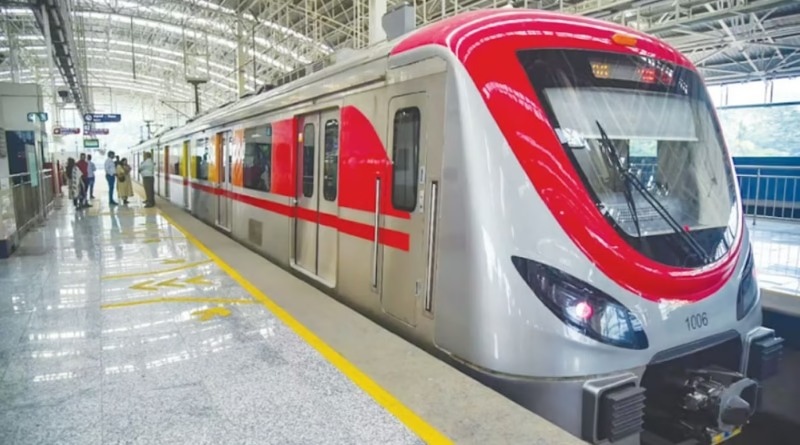
The Meerut Metro, touted as the country’s fastest metro service, covers 23 kilometres in about 30 minutes.
Designed for a top speed of 135 kmph and an operational speed of up to 120 kmph, it connects 13 stations, including Meerut South, Partapur, Rithani, Shatabdi Nagar, Meerut Central, Begumpul, Meerut North and Modipuram.
The project is being seen as a major boost to regional connectivity.
Earlier this month, the Cabinet Committee on Economic Affairs cleared the 11.6 km extension of the Noida Metro Aqua Line from Sector 142 to Botanical Garden. Once completed, the metro network across Noida and Greater Noida will exceed 61 kilometres.
The Botanical Garden station will serve as a key interchange with the Delhi Metro’s Blue and Magenta lines, while the extension will also link the upcoming multi-modal transport hub at Boraki.
Yet, despite these developments, transport planners and urban analysts point out that Uttar Pradesh still lags behind several other large states in terms of widespread metro connectivity.
While cities like Delhi, Mumbai, Bengaluru and Hyderabad boast expansive and well-integrated metro systems, only a handful of cities in Uttar Pradesh — including Lucknow, Noida, Ghaziabad, Kanpur, Agra and now Meerut — currently have operational metro services.
Vast stretches of the state, particularly tier-2 and tier-3 cities, continue to rely heavily on overcrowded buses and private vehicles.
Rapid urbanisation has intensified traffic congestion in smaller cities, where narrow roads and rising vehicle ownership frequently result in gridlock. Daily commuters often endure long delays, unreliable bus services and mounting fuel costs.
Analysts argue that introducing metro or light-rail systems in clusters of adjoining districts could provide a practical solution.
Connecting neighbouring towns that share borders would not only decongest roads but also improve access for rural populations who depend on time-consuming bus travel.
Transport experts believe that an integrated regional metro network linking smaller urban centres could dramatically improve mobility, stimulate local economies and reduce environmental stress.
Without such expansion, they warn, traffic bottlenecks and pollution levels are likely to worsen as vehicle numbers continue to rise.
While recent projects reflect encouraging momentum, many feel that Uttar Pradesh must accelerate metro expansion beyond a few prominent cities if it aims to match the scale and efficiency of public transport systems seen in larger metropolitan regions outside the state.
#UttarPradesh #MetroRail #UrbanTransport #PublicTransport #TrafficCongestion #Infrastructure #RegionalConnectivity #SmartMobility


