
Nationwide Backlash Forces Supreme Court to Stay UGC’s New Equity Regulations
By Tajdar H. Zaidi
New Delhi: In what is being seen as one of the strongest waves of public resentment since the BJP came to power at the Centre, the Supreme Court on Thursday stayed the University Grants Commission’s newly notified Promotion of Equity in Higher Education Institutions Regulations, 2026, directing that the 2012 rules will continue to remain in force for now.
The apex court observed that the new framework suffers from “complete vagueness”, particularly Regulation 3(C), which defines caste-based discrimination.
The bench noted that such loosely worded provisions could be misused and said the language requires substantial modification.
The 2026 regulations were introduced with the stated objective of curbing caste-based discrimination in universities and colleges by mandating special committees, grievance redressal mechanisms, and helplines, especially for students belonging to Scheduled Castes (SC), Scheduled Tribes (ST), and Other Backward Classes (OBCs).
However, soon after their notification in January, the rules triggered a nationwide uproar.
For perhaps the first time since the BJP assumed power nationally, a policy decision has sparked such widespread opposition that even party workers and grassroots leaders have openly revolted.
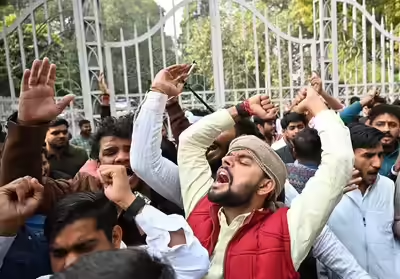
Protests erupted across campuses, with general category students leading demonstrations in Delhi University’s North Campus, Lucknow University, and several other institutions, demanding the immediate withdrawal of the regulations.
The anger has not remained confined to students alone. Lawyers, doctors, teachers, and other professionals have also voiced strong opposition, arguing that the growing layers of reservation and special provisions are steadily shrinking opportunities for meritorious candidates.
Adding to the political embarrassment for the ruling party, Shyam Sundar Tripathi, Vice President of the BJP Kisan Morcha from Rae Bareli’s Salon constituency, resigned from his post, calling the regulations a “black law” that was divisive and dangerous for society.
In a letter addressed to Prime Minister Narendra Modi, Tripathi said the policy went against his ideology and self-respect and reflected the deep resentment brewing among upper-caste communities.
While Union Education Minister Dharmendra Pradhan attempted to pacify critics by assuring that the regulations would not be misused and that there would be no discrimination in their implementation, the ground reality suggests otherwise.
“The upper caste is already reeling under the pressure of excessive reservation in multiple sectors, including competitive examinations.
Meritorious students are increasingly being left behind, while those with lesser knowledge and ability are moving ahead purely based on quotas,” said a BJP leader on condition of anonymity. “After 79 years of Independence, how long will this policy of appeasement continue?”
Echoing similar concerns, a retired college principal remarked, “On one hand, the Constitution speaks of equality, but on the other, the government itself keeps creating unequal frameworks. How can true merit survive in such a system?”
With the Supreme Court’s intervention, the controversial regulations have been put on hold, but the episode has laid bare the growing frustration within large sections of society — including within the BJP’s own ranks — over the expanding reservation regime and its long-term impact on merit, unity, and social harmony.
#UGCRegulations #SupremeCourtStay #ReservationDebate #StudentProtests #MeritVsQuota #NationwideUproar #HigherEducationCrisis #SocialJusticeOrAppeasement


