
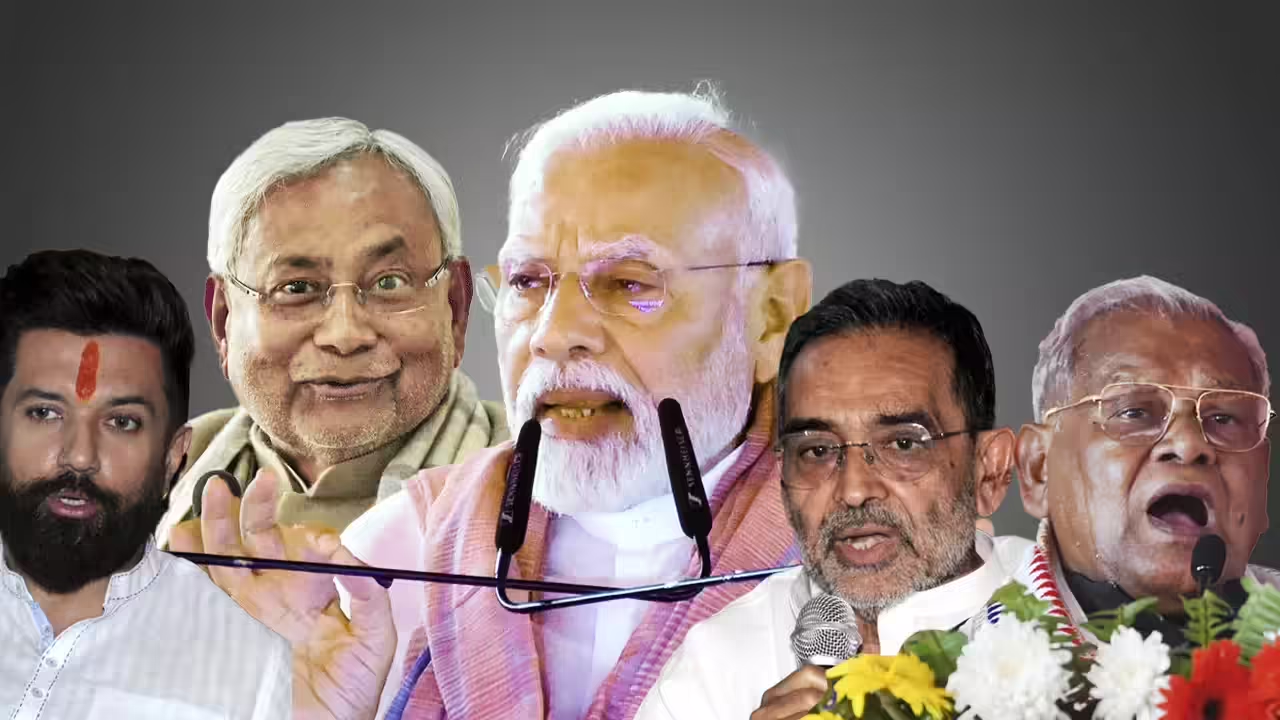
Nitish Kumar Scripts Historic Fourth-Term Comeback as NDA Crushes RJD-Led Alliance in Bihar
Returning to power for a fourth straight term is an uphill task for any government — securing a two-thirds majority is rarer still.
Yet, on November 14, Chief Minister Nitish Kumar and the National Democratic Alliance achieved precisely that, storming to a commanding victory in the Bihar Assembly elections.
With the JD(U)–BJP alliance poised to win around 202 of 243 seats, the verdict marked one of the most decisive mandates in Bihar’s recent political memory.
What makes this win remarkable is not just its scale but its timing. In 2010, the NDA’s sweeping mandate was anchored in Nitish Kumar’s ambitious governance overhaul after years of stagnation under RJD rule.
Today, the coalition has secured an equally emphatic victory in far tougher circumstances — battling anti-incumbency, questions over Nitish’s health, renewed opposition energy, and rising aspirations of a young electorate.
Why the NDA’s message resonated
Despite murmurs of fatigue after two decades in power, Nitish Kumar retained something that many long-serving leaders lose: credibility.
Across villages and towns, there remained a quiet acknowledgement that Nitish’s leadership had given Bihar roads, electricity, and safety at a time it desperately needed them.
That trust, though layered with rising expectations, proved decisive.
With this mandate, Nitish joins the ranks of India’s longest-serving chief ministers — leaders like Jyoti Basu and Naveen Patnaik — who transcended caste limitations through consistent governance.
Coming from a caste that forms barely 2.8% of Bihar’s population, Nitish has managed to build a broad coalition cutting across communities, particularly among EBCs, non-Yadav OBCs, and Mahadalits.
Welfare that arrived right on time
In an election where anti-incumbency loomed large, welfare became Nitish Kumar’s strongest shield.
Months before the polls, his government unveiled a series of financial support schemes — most notably, the ₹10,000 transfer to women to help them start small businesses, enhanced pensions for the elderly, and free electricity up to 125 units.
The timing was strategic. Over ₹20,000 crore was spent in the run-up to the polls, with instalments landing in beneficiaries’ accounts even as campaigning intensified.
For millions of women, elderly residents, and rural families, these benefits were tangible, punctual, and politically persuasive.
RJD’s promises struggled against the NDA’s delivery
The Mahagathbandhan, particularly Tejashwi Yadav, had hoped to build momentum through its own promises — monthly support for women, higher pensions, and lower electricity bills. Their campaign even mocked Nitish as “copying their ideas.”
But once Nitish implemented the schemes himself, the opposition’s pitch weakened. The election transformed into a direct contest between promised change and delivered relief — and the latter prevailed.
The last-minute promise of “one government job per household” from the MGB failed to inspire confidence even among Tejashwi’s loyal supporters, many of whom doubted the feasibility of such an ambitious pledge.
A social coalition that outpaced MY politics
While the RJD remains anchored to its core Yadav–Muslim vote bank — roughly a third of Bihar’s population — it has struggled for decades to expand beyond it.
Nitish Kumar, meanwhile, spent years cultivating communities outside traditional political blocs, especially EBCs and Mahadalits.
RJD’s candidate selection reflected its dependence on its base: out of 75 OBC candidates, 51 were Yadavs.
This reinforced the perception that the party’s focus remained narrow, undoing Tejashwi’s attempts to woo a broader coalition through outreach events and alliances with EBC-centric groups.
Women: Nitish Kumar’s most reliable constituency
Nitish Kumar was one of the first leaders in India to recognise women as a political force independent of caste calculations.
From providing free bicycles to schoolgirls in 2006 to reserving seats for women in local bodies and launching entrepreneurship schemes, he nurtured this constituency consistently.
These initiatives paid off again in 2025. In a state where many households are run by women while men migrate for work, Nitish’s programmes continued to earn strong loyalty among female voters.
The RJD’s old shadows returned.
For all of Tejashwi Yadav’s attempts to present a forward-looking RJD, memories of the 1990s — a period many recall as a time of lawlessness — continue to shape voter psychology.
Even though many years have passed, the imprint of that era remains vivid in Bihar’s heartland.
This legacy was compounded by the assertive mobilisation of Yadav supporters in RJD strongholds, which often triggered counter-mobilisation among non-Yadav OBCs, EBCs, and Dalits.
In essence, the RJD faced two battles simultaneously: an electoral fight with the NDA and a psychological struggle against its own past.
A verdict decades in the making
The NDA’s victory was not just the result of efficient campaigning — it was the culmination of years of slow, steady social engineering, tactical welfare, and Nitish Kumar’s reputation as a stable, if weary, administrator.
The RJD’s spirited campaign, though energetic, could not overcome the structural and emotional barriers that remain woven into Bihar’s political landscape.
#BiharElection2025 #NitishKumar #NDAVictory #RJD #TejashwiYadav #BiharPolitics #ElectionAnalysis


