
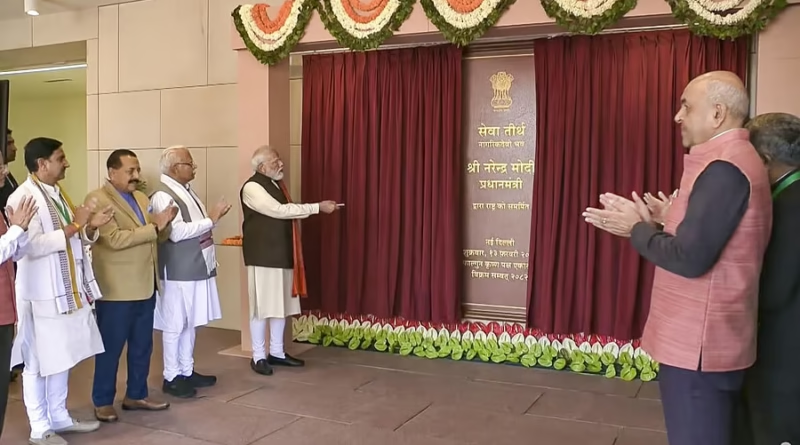
PM Modi Moves PMO to ‘Seva Teerth’, Marks Shift from Colonial-Era South Block
Prime Minister Narendra Modi on Friday began functioning from his new office at the Seva Teerth complex, relocating the Prime Minister’s Office from the historic South Block on Raisina Hill, which had housed the PMO since Independence.
The Prime Minister formally inaugurated the Seva Teerth complex along with two new Central Secretariat buildings—Kartavya Bhavan 1 and Kartavya Bhavan 2—describing the move as a symbolic and structural departure from colonial legacies.
He remarked that the North and South Block buildings were constructed during British rule as emblems of imperial authority and control.
According to Modi, the newly built complexes represent a governance model aligned with the aspirations of modern India.
He said decisions taken at Seva Teerth would reflect the collective hopes of 1.4 billion citizens rather than the mindset of monarchy or colonial power. With that spirit, he dedicated the facilities to the nation.
In a message shared on X, the Prime Minister expressed hope that Seva Teerth would embody service, responsibility and commitment to the principle of “India First,” and serve as an enduring reminder of public duty and dedication to citizens’ welfare.
The Executive Enclave—popularly referred to as Seva Teerth—has been developed on Dara Shikoh Road (formerly Dalhousie Road) as part of the Central Vista redevelopment initiative.
The complex also accommodates the National Security Council Secretariat and the Cabinet Secretariat.
In addition, Executive Enclave Part 2, which will include a new Prime Ministerial residence, is currently under construction nearby.
Shortly after assuming charge at the new office, Modi paid tribute at a statue of Lord Ganesha and approved a series of policy decisions focused on social welfare and economic growth.
Among them was the PM RAHAT scheme, which provides cashless medical treatment up to ₹1.5 lakh for accident victims.
Senior officials present at the event included Minister of State Jitendra Singh, National Security Advisor Ajit Doval, and Principal Secretaries P K Mishra and Shaktikanta Das.
The government also announced a significant expansion of flagship schemes.
The target under the Lakhpati Didi initiative—aimed at enabling rural women in Self-Help Groups to earn over ₹1 lakh annually through livelihood activities—has been doubled to six crore beneficiaries.
Further, the Agriculture Infrastructure Fund allocation has been increased from ₹1 lakh crore to ₹2 lakh crore to strengthen farm-related infrastructure.
A Startup India Fund of Funds 2.0, with an outlay of ₹10,000 crore, was also unveiled to support early-stage ventures and promote deep-technology innovation.
Modi stated that these measures reflect the guiding principle of “Nagrik Devo Bhava” (citizens as supreme) and reinforce the broader goal of building a developed India, or Viksit Bharat.
South Block had served as the PMO headquarters since the time of India’s first Prime Minister, Jawaharlal Nehru.
Constructed in the 1920s and 1930s during British rule, the Secretariat buildings were facing space constraints and structural wear, according to the Prime Minister.
He added that the shift to modern facilities would streamline operations and reduce recurring government expenditure on rentals and logistical arrangements.
In a related development, Delhi Metro’s Udyog Bhawan station has been renamed Seva Teerth following the inauguration of the new PMO complex.
#NarendraModi #SevaTeerth #CentralVista #PMO #KartavyaBhavan #ViksitBharat #GovernanceReforms


