
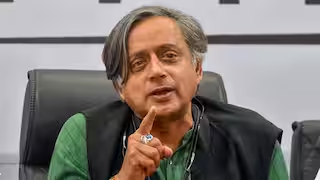
Shashi Tharoor Advocates Greater Debate in Parliament, Highlights Value of Dissent at Book Launch Discussion
Congress Member of Parliament Shashi Tharoor on Thursday emphasised that Parliament should function more as a platform for meaningful debate rather than frequent disruption, remarking that such a perspective is relatively uncommon within today’s Opposition.
He suggested that constructive dialogue is essential for strengthening democratic institutions.
Tharoor made these observations while speaking at the launch of Guardians of the Republic, authored by former Union Law Minister Ashwani Kumar. The discussion accompanying the release was moderated by noted political theorist Neera Chandhoke.
Responding to fellow panellists who raised concerns over the continued use of bulldozer-led demolitions of homes despite a Supreme Court ruling discouraging such actions, Tharoor referred to a historical instance in the United States where the President chose not to enforce a Supreme Court verdict.
He observed that the effectiveness of judicial pronouncements often depends on the willingness of the executive branch to implement them, as well as the degree of public pressure exerted on the government.
During the discussion, Ashwani Kumar remarked that the authority and respect enjoyed by the judiciary are shaped not merely by its pronouncements, but by the practical outcomes arising from those decisions.
He stressed that human dignity forms the foundation of democratic values, constitutional governance, and even the ideals of the freedom movement.
According to Kumar, the true measure of a society lies in the fairness and justice it is able to deliver to its citizens.
He further observed that those in positions of power cannot evade responsibility, noting that effective leadership remains central to addressing contemporary challenges.
Earlier in the event, Tharoor cited a passage from Kumar’s book stating that democracy cannot endure if authority becomes excessively concentrated, and that its survival relies as much on vigilance as on institutional design.
He noted that the book underscores the vital role played by dissent in preserving democratic vitality.
Tharoor also argued that the global shortage of principled leadership represents a serious risk, not only weakening institutions but also eroding the values that sustain them.
He remarked that the strength of a republic lies not only in its institutional framework but also in the ethical principles that inspire those institutions.
Notably, he did not directly mention either the Congress party or the BJP during his remarks.
Political analyst and social activist Yogendra Yadav commented that the concept of a republic carries profound significance, suggesting that it is insufficient to merely say the Constitution is under pressure.
According to Yadav, the deeper concern is that the essence of the republic itself has been weakening over the past decade.
He praised Kumar for maintaining balance, neutrality, and optimism in his writing.
However, Yadav added that the present circumstances require individuals to take clear positions, stating that the events in Gaza could only be described as genocide.
He also expressed concern that developments in Iran appear to signal a breakdown of the established global order.
Yadav questioned how bulldozer demolitions continued despite the Supreme Court’s ruling, observing that the apex court had earlier expressed strong displeasure over what he described as “three words in a textbook”.
He further noted that society may have struggled to articulate liberal democratic values in a way that resonates clearly with ordinary Hindus, Muslims, and Sikhs.
Columnist and author Gurcharan Das, another participant in the panel discussion, remarked that he finds himself unable to support the BJP, which he believes is weakening India’s liberal traditions, nor vote for Rahul Gandhi.
He also highlighted concerns about the massive backlog of approximately 50 million pending cases in courts, pointing out that a large number of prisoners remain incarcerated as undertrials.
Moderator Neera Chandhoke raised questions about why former Jawaharlal Nehru University students Sharjeel Imam and Umar Khalid have reportedly been denied bail for extended periods without the commencement of trial proceedings.
While acknowledging concerns regarding the diminishing legitimacy of dissent in recent times, Tharoor observed that the very fact that critical opinions could still be expressed publicly indicated that democratic space for disagreement continues to exist.
#ShashiTharoor #IndianParliament #Democracy #Dissent #GuardiansOfTheRepublic #AshwaniKumar #YogendraYadav #GurcharanDas #RahulGandhi #IndianPolitics #SupremeCourt #FreedomOfExpression #RuleOfLaw #Republic #PoliticalDebate


