
Trump Claims Major Military Success Against Iran as Analysts Warn of Wider Regional Fallout
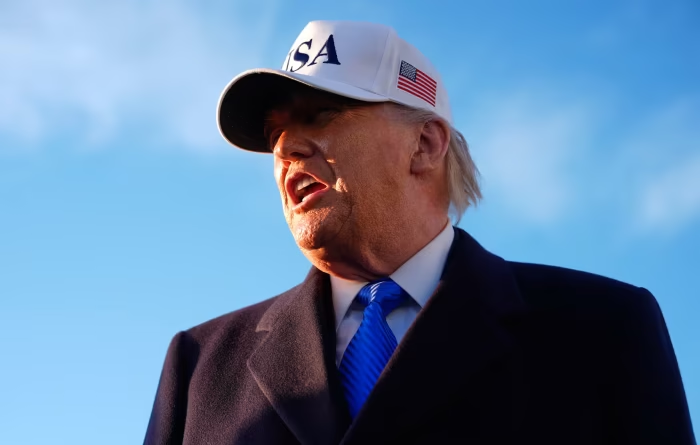
United States President Donald Trump on Sunday sharply criticised the leadership of Iran, portraying the regime as “brutal” and “ruthless” while asserting that American military operations had dealt a severe blow to Tehran’s defence capabilities.
Speaking to journalists aboard the presidential aircraft Air Force One, Trump said American strikes carried out against Iranian targets had produced decisive outcomes.
According to him, the military campaign had significantly weakened Iran’s armed forces.
“We achieved extremely effective results in Iran today. The military impact has been very powerful,” Trump said while addressing reporters.
He further maintained that the strikes had dismantled critical components of Iran’s defence infrastructure. “From my perspective, Iran has been largely subdued. There may still be some limited resistance remaining, but not much,” he added.
The US President also accused the Iranian authorities of issuing severe warnings against demonstrators. Referring to alleged government directives,
Trump claimed that Iranian officials had threatened to shoot protesters participating in anti-government demonstrations.
According to him, such warnings explain why large-scale protests have not yet materialised on the streets.
Trump also dismissed images circulating online that appeared to show massive gatherings in support of Iran’s Supreme Leader Ali Khamenei. He alleged that the visuals were fabricated using artificial intelligence and did not represent genuine public rallies.
“Iran claimed that nearly 250,000 people assembled in a public square to back Khamenei. That gathering never happened. The footage was artificially generated,” Trump asserted.
The US leader further claimed that the American offensive had destroyed a substantial portion of Iran’s air force, naval assets and air defence networks.
He said US forces had also targeted Kharg Island — Iran’s primary crude export hub in the Persian Gulf — although one section connected to oil pipelines was intentionally left undamaged.
Trump also indicated that Washington had initiated discussions with other nations about safeguarding the strategically crucial Strait of Hormuz, through which a large share of global petroleum shipments pass.
He noted that although the United States imports relatively small volumes of oil through the strait, several major economies rely heavily on energy supplies transported along this maritime corridor.
“We are consulting with other countries about securing the Strait of Hormuz because they are the ones whose oil shipments move through that route,” Trump said, adding that nations such as China are particularly dependent on energy supplies passing through the channel.
Tightened Security Inside Iran
Trump’s remarks came as reports indicated a heightened security presence across Tehran.
According to a report by BBC’s Persian-language service, residents in the Iranian capital have noticed an increase in checkpoints and patrols across several neighbourhoods.
Witnesses said security personnel were stopping vehicles and pedestrians for inspection at various locations.
Some residents also reported disruptions to internet connectivity, along with text alerts warning citizens against participating in anti-government protests.
These communication restrictions, according to the report, have made it significantly harder for people to coordinate demonstrations or organise gatherings.
The intensified security measures suggest that Iranian authorities may be attempting to prevent potential unrest at a time when regional tensions are escalating.
What Analysts Say About the US–Israel–Iran Conflict
Many geopolitical observers believe the confrontation involving the United States, Israel and Iran carries serious implications for the stability of the Middle East.
Strategic experts say the conflict could evolve into a prolonged regional crisis if hostilities continue to intensify.
Several analysts argue that the involvement of allied militia groups and regional partners increases the risk of a broader war spreading beyond the immediate theatre.
Energy market specialists have also warned that instability around the Strait of Hormuz could disrupt global oil supplies and trigger volatility in international energy prices.
Since roughly one-fifth of the world’s oil trade moves through the passage, any disruption could have far-reaching economic consequences.
Some political analysts believe Washington and its allies are attempting to weaken Iran’s strategic capabilities and deter its regional influence.
Others argue that Tehran may continue asymmetric retaliation through allied armed groups across the Middle East, potentially prolonging the conflict.
Diplomatic observers have emphasised that without sustained negotiations or mediation by major global powers, the confrontation could deepen divisions in the region and intensify humanitarian concerns.
As military exchanges and retaliatory attacks continue across the region, the evolving situation is being closely watched by governments and international organisations concerned about the possibility of a wider Middle Eastern conflict.
#USIranConflict #MiddleEastCrisis #DonaldTrump #IranIsraelWar #StraitOfHormuz #GlobalOilSupply #Geopolitics #WorldNews


