
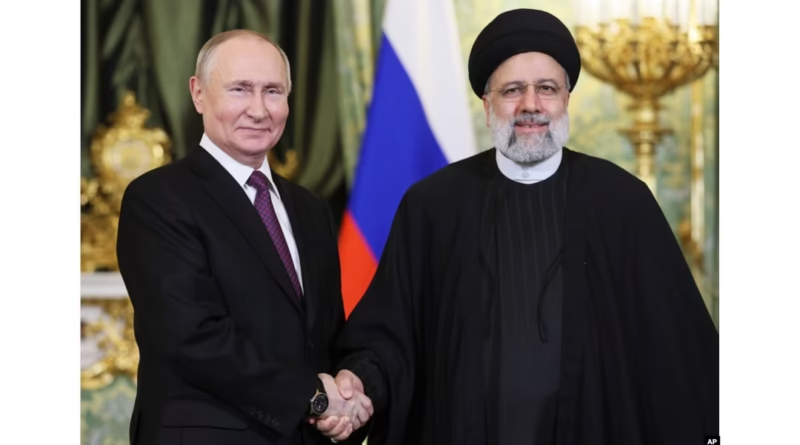
US–Israel Offensive on Iran Brings Strategic Gains and New Challenges for Vladimir Putin
One of the unexpected beneficiaries of the sweeping US-Israeli military campaign against Iran appears to be Russian President Vladimir Putin.
The surge in global oil and natural gas prices triggered by the conflict is strengthening Russia’s energy revenues, potentially easing pressure on Moscow’s struggling economy.
At the same time, Russia is positioning itself as a key alternative supplier of fuel in global markets as countries seek substitutes amid instability in the Middle East.
The crisis could also indirectly benefit Russia’s military campaign in Ukraine. If the escalating confrontation in the Middle East diverts American-made air defense systems away from Kyiv, Ukrainian forces may face greater difficulty defending their territory.
However, alongside these advantages, Putin is also confronting a geopolitical environment reshaped by US President Donald Trump’s assertive approach to global power.
Trump’s readiness to use American military strength aggressively has begun to curb Moscow’s influence and disrupt Russia’s long-standing strategy of supporting allied governments abroad.
For many years, the Kremlin maintained close ties with anti-American governments such as those in Iran, Venezuela, and Cuba.
During that period, Moscow rarely feared that Washington would directly use its overwhelming military capability to eliminate or forcibly remove those leaders. Trump’s recent actions suggest that this assumption no longer holds.
The US president has demonstrated a willingness to bypass traditional diplomatic constraints and international conventions, opting instead to project American power through direct and forceful interventions overseas.
Although Iran provided Russia with critical drone technology during the early stages of Moscow’s invasion of Ukraine four years ago, the Kremlin has largely stayed on the sidelines as the United States and Israel have targeted Iran’s political leadership and military infrastructure.
Russia’s response has mainly been limited to critical statements condemning the attacks, often carefully avoiding direct references to Trump.
Angela Stent, a specialist on Russian affairs and professor emerita at Georgetown University, said the situation highlights the limits of Russia’s partnerships.
“It raises the question of what it really means to be aligned with Moscow,” Stent said, noting that Iran had been particularly important in assisting Russia during the war in Ukraine.
When asked how Russia was supporting Iran during the crisis, Kremlin spokesperson Dmitry Peskov declined to provide details. Earlier, he stated simply that the ongoing conflict was “not our war.”
In recent weeks, US actions against governments friendly to Russia have unfolded at a rapid and dramatic pace.
Over the past two months, US-Israeli operations reportedly resulted in the killing of Iran’s supreme leader, Ayatollah Ali Khamenei. Meanwhile, American forces captured Venezuelan president Nicolás Maduro, and Washington imposed a severe economic blockade aimed at forcing Cuban leader Miguel Díaz-Canel from power.
In each of these situations, Russia has offered little visible assistance.
The spectacle of an American president pursuing foreign heads of state directly in their own countries—without significant resistance from Congress—has also altered the geopolitical dynamic that Putin long relied upon.
For years, Putin cultivated a reputation for bold risk-taking, unpredictability, ty and readiness to use military force as a means of projecting influence around the world.
Analysts now say that Trump’s assertive style has overshadowed that image.
Bobo Lo, a Russia expert and former Australian diplomat stationed in Moscow, suggested that Putin’s intimidating reputation has diminished.
“He’s no longer seen as the most feared actor on the global stage,” Lo observed. “That role has, to some extent, shifted toward Trump.”
According to Lo, the contrast makes Putin appear weaker than before in comparison to the aggressive posture of the United States.
In practical terms, Russia had limited options for defending Iran, said Alexander Gabuev, director of the Carnegie Russia Eurasia Center in Berlin.
With Russian forces deeply engaged in Ukraine, any attempt to protect Iran militarily would have risked confrontation with the United States or Israel—an escalation Moscow was unlikely to pursue.
Iran itself was already dealing with severe political and economic difficulties before the conflict began. Those vulnerabilities contributed to intelligence failures that allowed US and Israeli forces to strike swiftly at the highest levels of Iranian leadership.
Gabuev said the level of intelligence penetration inside Iran suggested that even coordinated support from Russia and China might not have prevented the outcome.
Still, analysts believe Putin may prefer to play a long-term strategic game rather than react immediately.
Trump has indicated that the United States does not necessarily intend to dismantle the political systems of countries where it intervenes or engages in prolonged nation-building efforts.
That leaves room for Russia to maintain relationships with sympathetic elites in those states.
At the same time, Trump’s second term in office has produced policies that sometimes advance Moscow’s interests.
In some areas, the US president has expanded American influence in regions that Russia traditionally considered within its sphere.
For example, Trump hosted leaders from Central Asia in Washington and helped negotiate a peace pledge between Azerbaijan and Armenia.
Yet in other instances, Trump’s decisions have indirectly benefited the Kremlin.
Moscow welcomed Trump’s heated confrontation with Ukrainian President Volodymyr Zelenskyy during a meeting in the Oval Office last year.
Russian officials also applauded Trump’s dismantling of the US Agency for International Development (USAID), which the Kremlin had long viewed as a vehicle for American political interference abroad.
Similarly, Trump’s criticism of the US-funded broadcaster Radio Free Europe/Radio Liberty aligned with Moscow’s longstanding opposition to Western media outlets operating in former Soviet territories.
Trump’s suggestion earlier this year that the United States might attempt to acquire Greenland from Denmark also risked creating tensions within NATO, potentially undermining the Western military alliance that Putin has long sought to weaken.
Despite the dramatic geopolitical shifts, Putin has refrained from openly criticising Trump.
Analysts believe the Russian leader is focused primarily on securing favorable conditions in the war in Ukraine.
During an interview with Politico on Thursday, Trump once again blamed Ukrainian President Volodymyr Zelenskyy rather than Putin for the lack of progress toward peace.
Even though Ukrainian forces managed to regain some territory during the final weeks of February—their first advance since 2023, according to the Institute for the Study of War—Trump repeated a message he had delivered to Zelenskyy during a tense Oval Office meeting the previous year.
“You don’t have the cards,” Trump said, suggesting that Ukraine lacked the leverage needed to shape the outcome of the conflict.
#Russia #VladimirPutin #IranConflict #USIsrael #GlobalPolitics #UkraineWar #DonaldTrump #Geopolitics


