West Asia War Enters Seventh Day as US Hardens Stand Against Iran, Naval Battle and Airstrikes Expand Conflict
The fast-escalating confrontation in West Asia reached a decisive and dangerous stage on Friday as the armed clash involving the United States, Israel and Iran moved into its seventh day.
What began on February 28 with a targeted strike against top leadership in Tehran has rapidly evolved from isolated air raids into a broad multi-front conflict, now stretching across land, sea and air.
Over the past week, the hostilities have expanded far beyond Iran’s borders, with naval combat reported in the Indian Ocean, missile interceptions across the Gulf region and multiple drone strikes hitting strategic locations.
Washington Hardens Its Position
In a dramatic escalation of rhetoric, Donald Trump made it clear that Washington is no longer considering diplomatic engagement with Tehran unless Iran fully capitulates.
Writing on his social media platform Truth Social, Trump declared that negotiations would not resume until Iran agreed to what he described as an “unconditional surrender.”
According to the American president, any future dialogue would only take place after Iran completely yields.
He stated that once that happens, the United States and its allies would work toward rebuilding Iran’s economy and restoring stability in the country.
Trump also used the slogan “Make Iran Great Again”, signalling a broader political objective aimed at reshaping the Iranian leadership structure.
Call for Internal Uprising
In another striking development, Trump publicly encouraged Kurdish groups within Iran to open an internal front against the central government.
Analysts say such statements suggest that Washington may now be pursuing a strategy aimed not merely at military pressure but at forcing a collapse of the current ruling establishment in Tehran.
Naval Battle in the Indian Ocean
The conflict widened significantly following a rare underwater engagement in the Indian Ocean.
US Defence Secretary Pete Hegseth confirmed that a United States Navy submarine had launched a torpedo attack on the Iranian frigate IRIS Dena near the southern coast of Galle.
The strike caused the vessel to sink, marking a significant escalation in naval warfare.
Officials reported that at least 87 Iranian sailors lost their lives in the incident, while 32 survivors were rescued by the Sri Lankan Navy and taken to hospitals in Galle for treatment.
Hegseth described the incident as a “silent elimination,” noting that it was the first time since World War II that a US submarine had destroyed an enemy warship using a torpedo.
White House Pushes Weapons Production
Meanwhile, President Trump convened a meeting in Washington with senior executives from several American defence manufacturing companies.
The objective of the gathering was to accelerate the supply of military equipment and ammunition required for ongoing operations in the Middle East.
White House press secretary Karoline Leavitt stated that the United States currently possesses sufficient stocks of weapons and ammunition to sustain its military campaign.
She added that Trump has long prioritised strengthening America’s armed forces, and the meeting with defence contractors had been scheduled weeks earlier as part of that strategy.
Oil Facility Fire in the UAE
In the Fujairah, a fire broke out at the Fujairah Oil Industry Zone after debris from an intercepted drone fell within the area.
Authorities said the blaze was quickly brought under control.
The facility, located beside the Port of Fujairah, is known to host the largest commercial storage infrastructure for refined petroleum products in the Middle East.
Explosions Reported in Iran
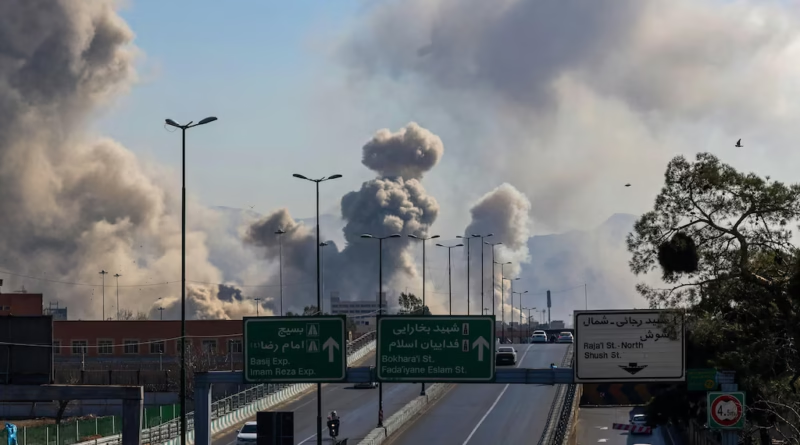
At the same time, residents in Tehran reported hearing several powerful explosions accompanied by thick plumes of smoke rising over parts of the city.
Similar blasts were also reported in the northern region near Rasht.
Authorities have not yet confirmed the intended targets of the strikes.
Americans Being Evacuated
Trump also revealed that the US State Department has begun quietly relocating American citizens from multiple countries across the Middle East.
He praised Secretary of State Marco Rubio for overseeing the evacuation efforts.
Earlier this week, the State Department confirmed that around 20,000 Americans had already returned home, with additional charter flights being arranged to assist others wishing to leave the region.
The evacuation plans were initiated after Washington issued advisories urging American nationals to depart from more than a dozen Middle Eastern countries.
Pakistan Reviews Energy Supplies
In neighbouring Pakistan, Prime Minister Shehbaz Sharif convened a high-level meeting to assess the possible impact of the war on the country’s fuel supplies.
During the meeting, the Ministry of Petroleum informed officials that national reserves of petroleum products remain sufficient to meet domestic demand.
Sharif directed provincial administrations to take firm action against hoarding or artificial shortages of fuel.
He warned that any petrol station involved in illegal stockpiling would face immediate closure, cancellation of its licence and legal penalties.
Hezbollah Launches Rocket Attacks
The regional conflict further intensified after Hezbollah announced it had launched rocket attacks on two locations in northern Israel.
According to the group, its fighters fired rockets at Malkia during the morning hours, followed by another barrage targeting Ramot Naftali later in the afternoon.
The attacks were described as retaliation for Israeli airstrikes carried out earlier in Lebanon.
War Shows No Sign of Slowing
As the seventh day of the confrontation unfolds, the crisis shows little indication of easing.
With expanding military operations, rising casualties and growing international involvement, the conflict now threatens to evolve into a broader regional war with far-reaching global consequences.
#MiddleEastWar #USIranConflict #IsraelIranWar #GlobalSecurity #WestAsiaCrisis #BreakingNews #Geopolitics