
Winter Session Erupts in Fierce Exchanges as SIR Debate, Election Reforms and Vande Mataram Anniversary Dominate Parliament
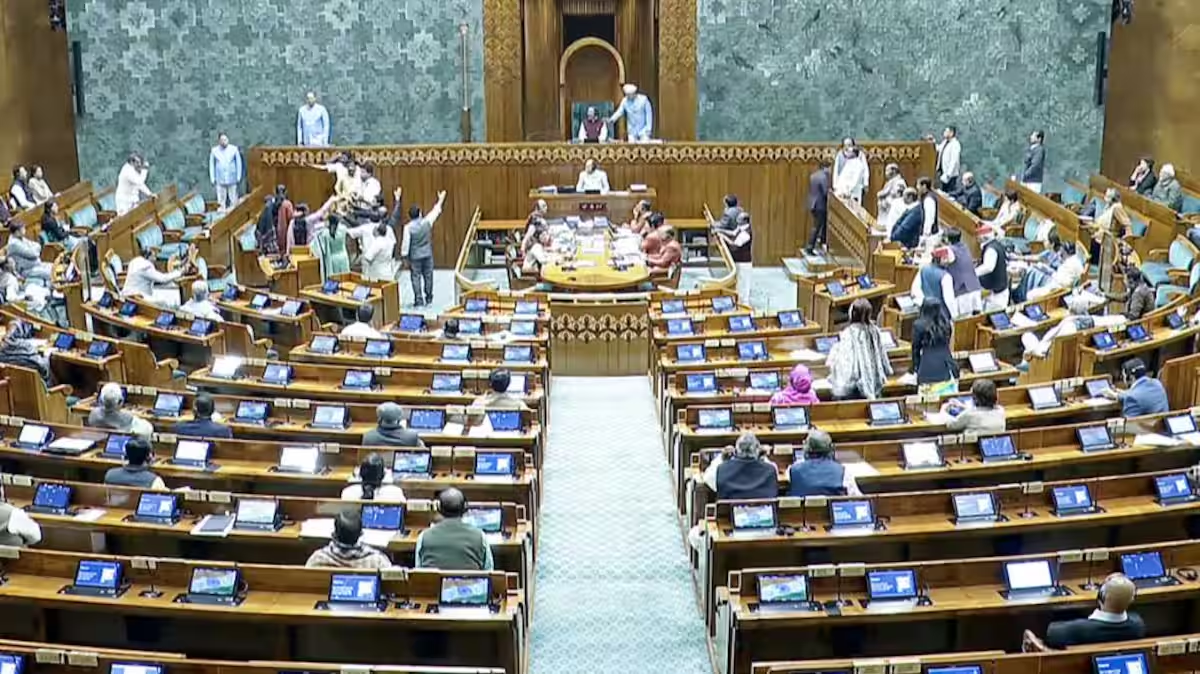
On the eighth day of the Winter Session, Parliament witnessed dramatic and emotionally charged scenes as the Lok Sabha and Rajya Sabha simultaneously debated two major themes—election reforms and the SIR controversy in the Lower House, and the 150th anniversary of Vande Mataram in the Upper House.
The day saw intense political clashes, sharp accusations and deeply polarised narratives from both the treasury and Opposition benches.
The Lok Sabha began its proceedings with an extended debate on election reforms.
Union Home Minister Amit Shah launched a strong counteroffensive against the Opposition’s allegations on the SIR process.
Reiterating that the BJP “never runs away from discussion,” Shah accused the Opposition of spreading “four months of one-sided lies” about SIR and diverting attention away from electoral reform proposals.
According to Shah, the Opposition’s credibility itself was in question. “If the voter lists were truly corrupt, why did you contest elections and take the oath after winning?
Explain this to the people,” he demanded, pointing out that under Prime Minister Narendra Modi’s leadership, the NDA has won three general elections, 41 state assembly elections and numerous other state-level polls since 2014.
These victories, he argued, undercut the charge that voter lists were being manipulated.
Shah added that the BJP had identified voter list discrepancies in Wayanad and Amethi as well, suggesting that the Opposition was choosing outrage only where convenient.
He then shifted to a historical criticism, citing three alleged incidents of “voter chori” in Indian political history.
Recalling the immediate post-Independence period, Shah said that when the first Prime Minister was to be elected, Sardar Patel received 28 votes and Jawaharlal Nehru only 2, yet Nehru was declared Prime Minister.
The BJP also mounted a strong defence of the Election Commission. Former Union Minister Ravi Shankar Prasad emphasised that the Election Commission had complete authority over the SIR process and dismissed allegations of coercion or misuse.
He pointed out that in Bihar, “not a single BLO lost their life” and no Opposition party had raised complaints earlier.
“When they win, the Election Commission is fine; when we win, they call it flawed,” he remarked, criticising what he called selective outrage.
This came a day after Congress MP Rahul Gandhi alleged that the BJP and the Election Commission were colluding to manipulate votes.
Speaking on election reforms, Gandhi accused the BJP and the RSS of capturing major institutions—including the Election Commission, ED, CBI, IB and the Income Tax Department.
He said the government was “directing the Election Commission,” which was harmful to democracy.
Gandhi demanded three major reforms to restore transparency:
- Machine-readable voter lists must be provided to all political parties one month before elections.
- Rules for destroying CCTV footage must be amended.
- EVMs should be open to inspection by political parties.
He also posed three direct questions to the government:
Why was the Chief Justice of India removed from the panel appointing Election Commissioners?
Why was the 2023 law amended to ensure the Election Commissioner cannot be penalised?
Why must CCTV footage be deleted 45 days after polling?
Calling vote-theft “anti-national,” Gandhi said the government had shown no interest in genuine electoral reforms.
Other Opposition MPs expanded on the concerns. SP chief Akhilesh Yadav accused the government of using SIR to secretly implement the NRC, claiming even detention centres were being prepared in Uttar Pradesh.
TMC MP Kalyan Banerjee alleged that SIR had become “a tool for deleting votes,” saying the Election Commission had no authority to determine citizenship, and that the BJP was celebrating mass voter deletions.
Congress MP Manish Tewari declared the ongoing SIR exercise in 12 states “illegal,” arguing that there was no constitutional provision for simultaneous SIR implementation across India.
He demanded that direct cash transfers before elections be banned and that ballot papers replace EVMs.
The Lok Sabha scheduled the SIR debate only after repeated protests by the Opposition.
Meanwhile, in the Rajya Sabha, the discussion on the 150th anniversary of Vande Mataram carried both cultural resonance and political undertones.
Amit Shah criticised the Congress for “misrepresenting” the significance of the national song, indirectly responding to Priyanka Gandhi’s claim that the timing of the debate was linked to the upcoming Bengal elections.
Shah reminded the House that when Vande Mataram turned 100, the colonial government had put the entire country under restriction, illustrating its profound association with India’s freedom struggle.
Congress President Mallikarjun Kharge defended his party’s legacy, pointing out that the 1937 Congress Working Committee—which included icons such as Mahatma Gandhi, Jawaharlal Nehru, Subhash Chandra Bose, Sardar Patel and Maulana Abul Kalam Azad—had unanimously resolved that only the first two stanzas of Vande Mataram be sung at national events.
“When you attack Nehru, you insult every leader who took that collective decision,” Kharge said.
He recalled his own six-decade-long association with the song and shifted briefly to criticise the government over the depreciation of the Indian rupee, prompting BJP president J.P. Nadda to intervene and urge him to “stay on the topic.”
Shah, continuing his remarks, said that the purpose of the discussion was to bring the song’s legacy to younger generations and described the moment as “historic.”
He emphasised the emotional power of Vande Mataram, saying, “When a soldier sacrifices his life, he utters Vande Mataram.”
Prime Minister Narendra Modi, during a previous event, had described the song as the “proclamation of India’s independence,” criticised its partial removal in 1937 and released a commemorative stamp, coin and official website dedicated to it.
Several factors are believed to be behind the government’s decision to highlight Vande Mataram at this moment: reinforcing national unity and cultural identity, signalling political momentum ahead of the Bengal elections, reopening debate on the 1937 changes to the song, recalling its central role in the 1905 anti-Partition struggle, and creating a unifying emotional narrative amidst the heated SIR controversy.
The historical journey of Vande Mataram is central to the ongoing debate.
Written by Bankim Chandra Chatterjee on 7 November 1875 and later included in his novel Anandamath, the song was first publicly sung by Rabindranath Tagore in 1896.
It became a rallying cry during the 1905 anti-Partition movement and was officially declared India’s national song on 24 January 1950 by the Constituent Assembly.
Amid these political and cultural confrontations, the government is preparing to introduce ten key bills in the Winter Session.
These include the Atomic Energy Bill, which would allow private and foreign companies to enter the nuclear power sector; the Higher Education Commission of India Bill, which would merge UGC, AICTE and NCTE into a single regulator; the National Highways (Amendment) Bill to streamline land acquisition; the Corporate Law Amendment Bill 2025 to improve business efficiency; and the Securities Markets Code Bill to merge major SEBI-related laws.
The 131st Constitution Amendment Bill would bring Chandigarh under Article 240, while amendments to the Arbitration and Conciliation Act aim to speed up dispute resolution across the country.
The day’s proceedings reflected the deeply polarised political climate of the Winter Session—split between accusations of institutional capture, counter-claims of misinformation and a simultaneous attempt to evoke national unity through the legacy of Vande Mataram.
#WinterSession2025 #ParliamentNews #ElectionReforms #SIRDebate #VandeMataram150 #AmitShah #RahulGandhi #LokSabha #RajyaSabha #IndianPolitics #BJP #Congress #DemocracyDebate #PoliticalShowdown


