
A Murder, a Map, and a Region on Edge: Why India Must Pay Attention to What Is Unfolding in Bangladesh
BK Singh
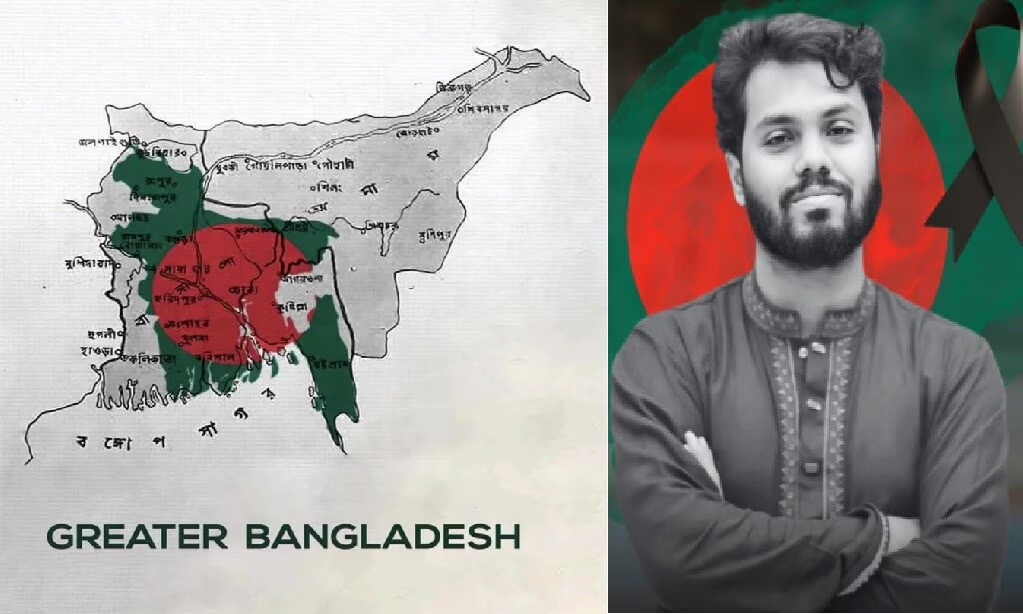
Just hours before he was attacked and killed, youth leader Sharif Osman Hadi, a prominent face of the Inqilab Manch, shared a provocative map of a so-called “Greater Bangladesh” — a map that brazenly included India’s northeastern states, popularly known as the Seven Sisters.
That image, now widely circulated, has since taken on a far more disturbing significance in the wake of his killing and the political messaging that followed.
In the aftermath of Hadi’s death, Abdullah Al Jaber, a colleague from Inqilab Manch, issued a 24-hour ultimatum to the interim government of Bangladesh, demanding a public disclosure of the steps taken to identify and arrest those responsible for the murder.
The ultimatum was directed at the interim administration led by Muhammad Yunus, placing immediate pressure on a government already facing growing scrutiny.
At Hadi’s funeral, held at the South Plaza of the Jatiya Sangsad Bhaban, Yunus struck a deeply emotional tone.
Addressing a large gathering of political leaders, activists, and supporters, he described Hadi as a unifying national figure whose ideals would endure “as long as Bangladesh exists.”
He praised the slain youth leader’s humility, grace, and ability to connect with ordinary citizens, pledging that Bangladesh would keep its “head held high before the world” and that the promises Hadi made to the people would be fulfilled.
Those words, however, have raised troubling questions across India.

The namaz-e-janaza of Osman Hadi was held on Saturday afternoon and led by his elder brother, Abu Bakar Siddique.
As tributes poured in and Yunus vowed that Hadi would “never be forgotten” and would remain alive in the nation’s heart for generations, critics began to ask: what exactly are the “dreams” and “promises” that the Bangladeshi leadership now claims it will fulfil?

The concern deepened further with reports of escalating violence against minorities in Bangladesh.
In a chilling incident, Dipu Chandra Das, a Hindu factory worker, was lynched by a mob and his body set ablaze.
The Indian Consulate was also attacked, leaving four people injured.
These incidents have reinforced fears of a systematic targeting of minority Hindus and the growing dominance of radical Islamist elements within the country.
Congress leader Shashi Tharoor, reacting on X, condemned the lynching and demanded to know what the Bangladeshi authorities were doing to punish the perpetrators and prevent such barbaric crimes in the future.
Writer and activist Taslima Nasreen offered a harrowing account of the lynching, stating that Dipu was falsely accused of blasphemy by another labourer over a trivial personal dispute — a single shout that was enough to incite the mob.
The victim was stripped, tied to a tree, and set on fire, underscoring how fragile law and order have become.
All of this is unfolding against a deeply unsettling regional backdrop. To India’s west, Pakistan continues to look for opportunities to provoke conflict.
To the north and east, China speaks the language of peace and dialogue while simultaneously reviving its long-standing pressure tactics — most recently by reiterating claims over Arunachal Pradesh, an integral part of India, even as Beijing has already entrenched itself in Tibet.
Now, to India’s east, Bangladesh appears to be sliding into radicalisation, with extremist rhetoric, minority persecution, and irredentist imagery gaining ground.
In this context, the map circulated by Osman Hadi before his death cannot be dismissed as a fringe provocation.
When the caretaker chief adviser of Bangladesh publicly promises, at the funeral of such a leader, to fulfil all his dreams, it is only natural for Indians to ask uncomfortable but necessary questions.
Does the Bangladeshi leadership reject outright the idea of annexing India’s northeastern states? Or does its silence signal something more ominous?
Every true Indian has the right to demand clarity. If Muhammad Yunus chooses to remain silent on this issue, many will inevitably conclude that his government harbours hostile intentions toward India — intentions seemingly reinforced by the emotive pledge made at the very graveside where Hadi was laid to rest.
Equally pressing are questions for New Delhi.
What is the Government of India doing to safeguard the interests and lives of Hindus in an increasingly radicalised Bangladesh?
Has the Ministry of External Affairs issued even a clear and forceful statement of condemnation?
With two deeply radicalised or hostile environments now flanking India on both its eastern and western borders, how is the nation strengthening its diplomatic, strategic, and security preparedness?
These are not rhetorical questions. They go to the heart of India’s national security, its regional stability, and its moral responsibility toward vulnerable minorities beyond its borders.
Silence, whether in Dhaka or New Delhi, will only embolden forces that thrive on chaos, hatred, and expansionist dreams.
#BangladeshCrisis #NationalSecurity #SevenSisters #HinduPersecution #RadicalIslam #IndiaBangladesh #Geopolitics #MinorityRights #MEA #RegionalStability


