
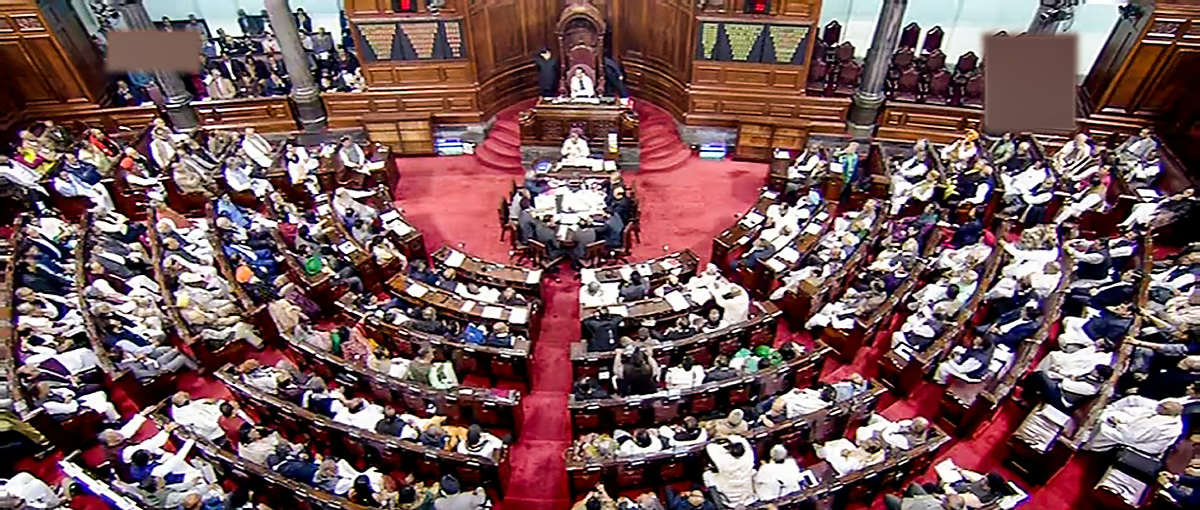
BJP Set to Gain Upper Hand as Rajya Sabha Polls for 37 Seats Scheduled on March 16
By Tajdar H. Zaidi
New Delhi: The Election Commission has announced that biennial elections to 37 Rajya Sabha seats across 10 States will be conducted on March 16, setting the stage for a significant political reshuffle in the Upper House of Parliament.
The seats are falling vacant in April, and the upcoming contest is widely expected to strengthen the ruling National Democratic Alliance (NDA), led by the Bharatiya Janata Party (BJP).
With the BJP either in power or part of the ruling alliance in six of the 10 States going to polls, the party appears poised to expand its footprint in the Rajya Sabha.
States Going to Polls
The 37 seats are distributed across the following States:
- Maharashtra – 7 seats
- Tamil Nadu – 6 seats
- West Bengal – 5 seats
- Bihar – 5 seats
- Odisha – 4 seats
- Assam – 3 seats
- Telangana – 2 seats
- Chhattisgarh – 2 seats
- Haryana – 2 seats
- Himachal Pradesh – 1 seat
The seats will fall vacant on April 2 and April 9. Notifications for the elections will be issued on February 26. Polling will take place between 9 a.m. and 4 p.m. on March 16, with counting scheduled from 5 p.m. the same day.
Political Arithmetic Favors NDA
The ruling BJP and its allies are likely to emerge stronger in this round of elections. Currently, nine retiring members belong to the BJP, while two are from its ally JD(U).
Other BJP-aligned parties — RPI (A), AIADMK, Tamil Manila Congress, and RLM — each have one retiring MP.
On the other side, 19 retiring members are from the opposition INDIA bloc. These include four each from Congress, DMK, and Trinamool Congress; two each from NCP (SP) and Samajwadi Party; and one each from Shiv Sena (UBT), CPI(M), and an Independent member.
Additionally, two BJD and one BRS member are also retiring.
Given the current strength of State Assemblies — which elect Rajya Sabha members — the NDA is projected to increase its tally from 15 to nearly 25 seats in this cycle, while the INDIA bloc may see its numbers reduced from 19 to around 10.
State-wise Outlook
- Maharashtra: With seven seats up for grabs and the INDIA bloc having suffered setbacks in the 2024 Assembly polls, opposition parties may be reduced to just one seat despite four of their MPs retiring.
- Bihar: Of the five seats, JD(U) and RJD hold two each, and one is held by RLM. The BJP-JD(U) alliance is expected to hold an advantage.
- Odisha: The BJP is likely to secure three out of four seats, leaving one possibly for the BJD.
Prominent leaders whose terms are ending include Sharad Pawar, Abhishek Singhvi, Saket Gokhale, Ramdas Athawale, M. Thambidurai, and Tiruchi Siva.
Understanding the Rajya Sabha: Role, Strength, and Significance
The Rajya Sabha, or the Council of States, is the Upper House of India’s Parliament. It plays a crucial role in legislative scrutiny and federal balance.
Total Strength
The Rajya Sabha has a maximum strength of 250 members:
- 238 members are elected by the elected members of State Legislative Assemblies and Union Territories through proportional representation.
- 12 members are nominated by the President of India for their expertise in fields such as literature, science, art, and social service.
Currently, the effective strength is 245 members.
Tenure
- Each member serves a six-year term.
- One-third of the members retire every two years, ensuring continuity.
- Unlike the Lok Sabha, the Rajya Sabha is a permanent body and is never dissolved.
Key Functions
Legislative Role:
The Rajya Sabha debates and passes bills (except Money Bills, where it has limited powers). Most legislation requires approval from both Houses.Review and Deliberation:
It acts as a revising chamber, scrutinizing laws passed by the Lok Sabha Federal Representation:
It represents the interests of States at the national level, reinforcing India’s federal structure.
Special Powers:
- Can authorize Parliament to make laws on State List subjects in national interest (Article 249).
- Can create new All India Services.
- Plays a role in impeachment proceedings and constitutional amendments.
- Checks and Balances:
Although the Lok Sabha has overriding powers in financial matters, the Rajya Sabha provides institutional balance and continuity in governance.
Why These Elections Matter
With no single party currently enjoying an absolute majority in the Rajya Sabha, even incremental gains can significantly impact legislative strategy. A strengthened NDA presence would ease the passage of key reforms and bills, reducing reliance on smaller parties for support.
As March 16 approaches, political observers will closely watch how the numbers reshape the power dynamics in Parliament’s Upper House.
#RajyaSabhaElections #ParliamentOfIndia #UpperHouse #BJP #NDA #INDIABloc #IndianPolitics #ElectionCommission #March16Polls


