Endgame in Caracas: How a US Strike Toppled Nicolás Maduro and Reset Venezuela’s Power Equation


The long-running confrontation between Washington and Caracas appears to have reached its dramatic climax.
In a stunning sequence of events that unfolded over the night of January 2, the United States carried out a decisive military operation in Venezuela that, by American claims, ended with the capture of President Nicolás Maduro and his wife Celia Flores, and the effective collapse of his hold on power.
By January 3, the message from Washington was unmistakable. Speaking publicly, US President Donald Trump declared the operation a success, signalling that Maduro’s era was over and that a transition was already underway in Caracas.
The Night the Balance Shifted
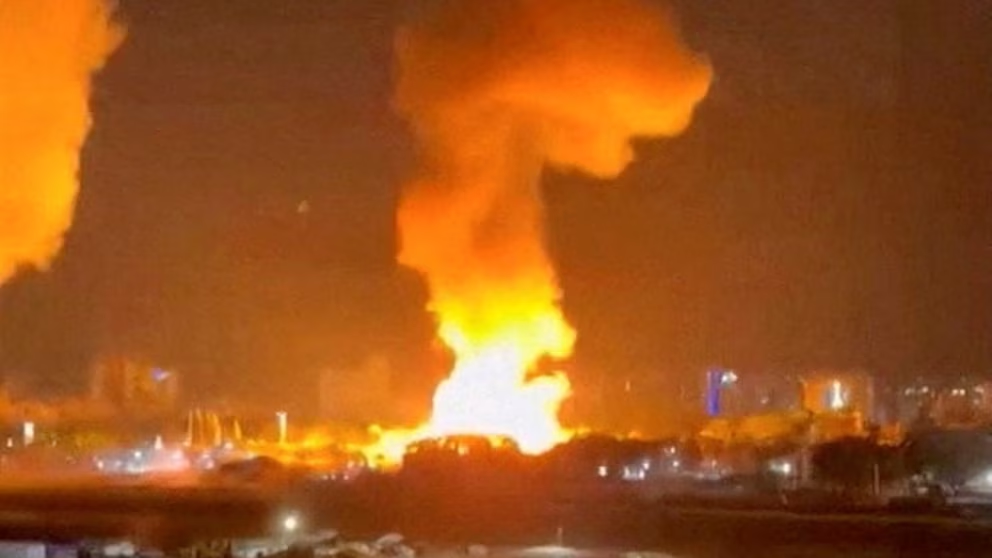
According to US accounts, the operation began with coordinated air and precision strikes across four Venezuelan cities, including Caracas, Miranda, Aragua and La Guaira.
Seven military installations were hit in rapid succession, paralyzing command structures and air defences.
Within hours, US special forces moved in, targeting what Washington described as “regime command nodes.”
Venezuela’s Defence Minister confirmed that US strikes had taken place, condemning them as an assault on sovereignty.
But by then, the political centre of gravity had already shifted. Reports emerging soon after claimed that Maduro and his wife had been detained and flown out of the country, later surfacing in US custody.
Trump’s Objectives Laid Bare
From the outset, Trump made little effort to hide his intent. He framed the strike around two objectives: dismantling drug cartels allegedly operating with state protection in Venezuela, and removing what the US has long labelled a “dictatorial regime.”
In interviews following the operation, Trump praised what he called “brilliant planning” and the role of elite US forces, widely reported to include the secretive Delta Force.
Questions about congressional approval and international legality were brushed aside, with Trump indicating that further details would be addressed “at the right time.”
A Transition Backed from Washington
As Maduro vanished from the political stage, reports began circulating that Venezuela’s vice president had assumed control of day-to-day governance.
Crucially, this transition is said to have taken place with tacit approval from Trump, suggesting that Washington now views the interim leadership as acceptable—and workable.
For many analysts, this marked the real endgame. With Maduro removed, the US appears poised to shape Venezuela’s political and economic future, something it has sought for years through sanctions, diplomatic pressure and covert manoeuvres.
Global Backlash, Limited Leverage
The reaction from US rivals was swift but largely rhetorical. China condemned the seizure of a sitting president, calling it a violation of international norms and urging dialogue.
North Korea went further, branding the action “hooliganism” and a grave attack on sovereignty.
Russia also voiced support for Venezuela’s government and people. Yet, beyond statements, none of these countries appeared willing — or able — to challenge the new reality on the ground.
Several experts noted that with global priorities stretched and Trump back in the White House, Caracas had slipped down the list of causes worth confronting Washington over.
Oil, Power and the Real Prize
Behind the military drama lies Venezuela’s vast oil wealth. Once dubbed the Saudi Arabia of Latin America, the country holds the world’s largest proven crude reserves.
China has been the dominant buyer in recent years, but a post-Maduro Venezuela could reopen the doors to US energy giants.
Analysts argue that Washington now has a clear path to reassert influence — securing oil supplies, reducing China’s footprint, curbing migration routes and tightening control over alleged narcotics corridors.
US companies, which have been sidelined by sanctions, stand to gain major contracts in energy, infrastructure, and mining.
The Curtain Falls on Maduro
For more than a decade, Nicolás Maduro survived sanctions, diplomatic isolation, internal protests and international pressure. But this time, the force applied was overwhelming.
With his removal, the US has effectively ousted one of its most defiant adversaries in the Western Hemisphere.
Whether Venezuela stabilizes or descends into fresh turmoil remains uncertain. What is clear is that the strategic contest appears, for now, almost over. Washington has its opening, its preferred transition, and the leverage it long sought.
For Venezuela, a new — and heavily contested — chapter has begun.
#VenezuelaCrisis #MaduroCaptured #USStrike #Caracas #DonaldTrump #Geopolitics #OilPolitics #LatinAmerica #PowerShift