
Yogi Adityanath Backs Women’s Reservation Bill After Defeat in Parliament, Calls It a Step Towards Cleaner and More Inclusive Politics
Lucknow: The debate over the proposed 131st Constitutional Amendment Bill, aimed at providing 33 per cent reservation for women in an expanded Lok Sabha and state Assemblies, took a deeply emotional turn after Uttar Pradesh Chief Minister Yogi Adityanath on Sunday criticised Opposition parties for their conduct in Parliament, likening the scene to the “cheerharan” of Draupadi from the Mahabharata.
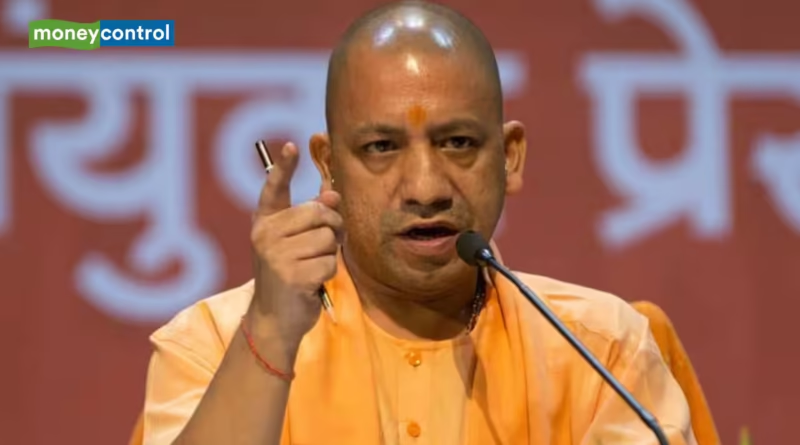
Addressing mediapersons, Adityanath said the behaviour of leaders from the INDIA bloc — including the Congress, Samajwadi Party, TMC and DMK — during the debate was disappointing at a time when the country expected unity on an issue concerning women’s empowerment.
“The scene that played out in the House reminds one of the disrobing of Draupadi in the royal court.
The kind of remarks made and the manner in which the debate unfolded are known to everyone,” the Chief Minister said, expressing concern over what he described as attempts to derail a measure intended to enhance women’s participation in governance.
Singling out the Samajwadi Party for raising the issue of separate reservation for Muslim women, Adityanath said such demands distracted from the core objective of ensuring greater representation for women across communities.
He said the Constitution’s framers had debated the issue of religion-based reservation and rejected it, stressing that the Bill should be viewed through the larger lens of equality and empowerment.
“They speak of the Constitution, but often act against the spirit of Baba Saheb B R Ambedkar,” Adityanath remarked, arguing that the legislation was rooted in the vision of social justice and equal opportunity.
Calling the proposed amendment a progressive step, the Chief Minister said the measure did not curtail anyone’s rights but sought to open doors that had historically remained closed to many capable women.
“This is a step guided by progressive thinking for women’s empowerment. It does not take away anyone’s rights,” he said.
The Bill, which required a two-thirds majority, failed to secure passage in the House on Friday, marking a rare legislative setback for the Narendra Modi government.
The proposed amendment sought to operationalise reservation for women after delimitation of constituencies in line with demographic changes.
Adityanath also referred to assurances given by Prime Minister Narendra Modi and Union Home Minister Amit Shah to southern states, which had expressed concerns that their share of parliamentary representation could decline after delimitation based on the 2011 Census framework.
According to the Chief Minister, the central leadership had made it clear that representation across regions would increase proportionately.
Beyond the political exchange, the debate has stirred conversations across several cities in Uttar Pradesh about the broader significance of women’s representation in public life.
Many citizens view enhanced participation of women in legislatures as a step towards more balanced and responsible policymaking.
Observers point out that a greater presence of women lawmakers could gradually transform the tone of political discourse, encouraging issues such as education, health, safety and social welfare to find a stronger voice in legislative priorities.
Some also believe that expanding opportunities for women in Parliament and Assemblies may contribute to a gradual decline in the number of legislators facing serious criminal charges, thereby improving public confidence in democratic institutions.
For many supporters of the Bill, the question extends beyond party lines and immediate political outcomes.
They see it as part of a longer journey towards ensuring that governance reflects the aspirations and experiences of half the country’s population.
As the debate continues, the proposed women’s reservation framework has once again drawn attention to the evolving character of Indian democracy — one where representation, dignity and equal participation remain central to the promise of the Constitution.


