
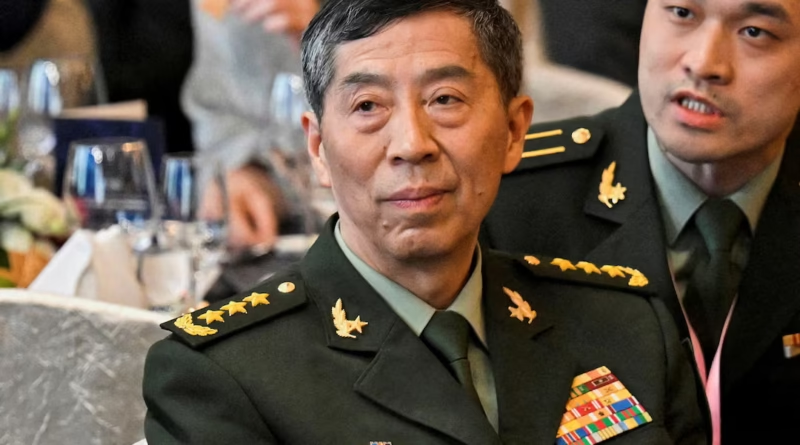
China Sentences Former Defence Ministers Wei Fenghe and Li Shangfu to Death With Reprieve in Massive PLA Corruption Crackdown
 In one of the most dramatic military purges in modern Chinese history, China has sentenced two former defence ministers — Wei Fenghe and Li Shangfu — to death with a two-year reprieve in a sweeping corruption scandal that has shaken the highest levels of the People’s Liberation Army (PLA).
The verdicts, announced through Chinese state media on May 7, 2026, mark one of the harshest punishments handed down against senior military officials in recent decades and underscore the intensity of President Xi Jinping’s anti-corruption campaign within the armed forces.
Military courts found both former ministers guilty of serious bribery and corruption offences involving military appointments, procurement deals and abuse of power.
Under Chinese law, a “death sentence with reprieve” generally means that execution is suspended for two years. In many cases, the punishment is later reduced to life imprisonment if the convict does not commit additional offences during that period.
However, authorities indicated that both Wei and Li would face life imprisonment without parole or any possibility of sentence reduction after commutation — a clear indication of how seriously Beijing views the scandal and the political message it intends to send.
Wei Fenghe: Once among Xi’s most trusted generals
Wei Fenghe served as China’s defence minister from 2018 to 2023 and was once considered one of the most influential figures in the Chinese military establishment.
Before becoming defence minister, Wei commanded the PLA Rocket Force, the elite branch responsible for China’s conventional and nuclear missile arsenal. His rise through the military hierarchy was closely linked to Xi Jinping’s push to modernise the armed forces and strengthen party control over the military.
Wei also served on the powerful Central Military Commission (CMC), the top body overseeing China’s military affairs.
Investigators accused him of accepting massive bribes, manipulating military promotions and helping individuals secure influential postings inside the PLA in exchange for financial benefits.
Chinese authorities described his actions as causing “tremendous harm” to both the armed forces and the Communist Party’s credibility.
Li Shangfu’s rapid fall from power
Li Shangfu’s downfall was even more dramatic because of how quickly it unfolded.
Li succeeded Wei as defence minister in 2023 but vanished from public view only months after assuming office, triggering widespread speculation about an internal political purge within the Chinese military leadership.
He was later formally removed from office without any detailed public explanation.
Before becoming defence minister, Li headed the PLA’s Equipment Development Department, a critical institution responsible for overseeing military procurement and weapons development programs.
Prosecutors accused him of involvement in corruption linked to defence contracts, procurement deals and bribery involving military suppliers.
Authorities alleged that Li both accepted and offered bribes in exchange for influence over military acquisitions and appointments.
Li had already drawn international attention years earlier after the United States imposed sanctions on him in 2018 over China’s purchase of Russian fighter jets and missile systems.
At the time, the sanctions became a major diplomatic issue between Beijing and Washington.
Why the case is unprecedented
Analysts believe the sentencing represents a major escalation in Xi Jinping’s long-running anti-corruption campaign, which has targeted thousands of Communist Party officials, military officers and business elites since he came to power in 2012.
Xi has repeatedly warned that corruption poses a serious threat to the Communist Party’s authority and military effectiveness.
However, observers say the punishment of Wei and Li stands apart because both men occupied the very top tier of China’s military and political hierarchy.
Both served as:
- Defence ministers,
- Senior PLA generals,
- Members of the Central Military Commission,
- Key figures in China’s military modernisation efforts.
According to international analysts, it is extremely rare for former CMC members to face such severe punishment, making the case one of the most consequential military corruption scandals in recent Chinese history.
Deepening crisis inside the PLA
The convictions are part of a much broader anti-corruption sweep that has been unfolding inside the Chinese military since 2023.
The crackdown has particularly affected the PLA Rocket Force — one of China’s most strategically important military branches.
Over the past several years, numerous senior officers, commanders and military officials have reportedly disappeared from public view, been dismissed or placed under investigation.
Even some generals previously believed to be politically close to Xi Jinping have reportedly fallen from favour.
The scale of the purge has triggered intense speculation internationally about the depth of corruption within China’s military system.
Several critical questions are now being raised:
- Has corruption deeply penetrated China’s defence procurement structure?
- Were military modernisation projects compromised by bribery and political favouritism?
- Is Xi using the campaign not only to fight corruption but also to consolidate political loyalty inside the armed forces?
Western security analysts believe the purge may be disrupting military readiness, command structures and internal confidence within the PLA at a time when China is rapidly expanding its military capabilities and increasing pressure in regions such as the Taiwan Strait and the broader Indo-Pacific.
What “death with reprieve” really means
China frequently uses suspended death sentences in politically sensitive corruption cases involving senior officials.
Typically, the punishment follows a specific process:
- The accused is formally sentenced to death.
- Execution is suspended for two years.
- If the prisoner does not commit additional offences, the sentence is usually reduced to life imprisonment.
In the cases of Wei and Li, however, Chinese authorities made clear that even after commutation, neither man would ever be eligible for parole or sentence reduction.
This makes the punishment both symbolic and political.
It publicly brands the two former ministers as examples of extreme corruption while also warning other military officials about the consequences of disloyalty, abuse of power or financial misconduct.
Xi Jinping’s larger political message
The sentencing is widely being interpreted as a powerful signal from Xi Jinping that no rank within the military is beyond scrutiny.
Chinese military newspapers have already urged officers across the PLA to treat Wei and Li as “cautionary examples” and warned personnel against “divided loyalties” within the armed forces.
Many analysts believe the anti-corruption campaign now serves multiple purposes beyond simply cleaning up financial misconduct.
It is also seen as an effort to ensure absolute political obedience to the Communist Party leadership at a time when China faces growing geopolitical tensions with the United States, military competition in the Indo-Pacific and increasing pressure surrounding issues such as Taiwan.
For Xi Jinping, maintaining unquestioned control over the military appears to have become as strategically important as military modernisation itself.
The sentencing of two former defence ministers — once among the most powerful men in China’s military establishment — has now become one of the clearest signs yet of how far Beijing is willing to go to enforce that control.


