
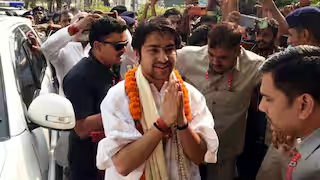
“Hanumant Katha Begins in Prayagraj: Dhirendra Krishna Shastri Calls for Unity, Devotion and Strength of Sanatan Values”
Prayagraj: The sacred banks of the Triveni came alive on Tuesday as the three-day Hanumant Katha, organised by Prayag Utthan Samiti, commenced at Arail Ghat in Prayagraj.
In the midst of intense summer heat, thousands of devotees gathered with unwavering faith, their devotion transforming the atmosphere into one of collective spiritual energy.
As Dhirendra Krishna Shastri took his place on the Vyas Peeth, the ceremony began with an aarti, setting the tone for what would become a deeply immersive spiritual experience.
With folded hands and a resonant voice, he led the gathering in chants of “Shri Ram Jai Ram, Jai Jai Ram”, followed by repeated invocations of “Sita Ram–Hanuman.”
The response from the devotees was overwhelming — voices rising together, echoing across the riverbanks, creating a sense of unity that transcended the physical setting.
Observing the enthusiasm of the crowd despite the scorching heat, Shastri paused to reflect on the spirit of devotion.
In his characteristic conversational style, he spoke of a vision of temples filled with faith, of streets filled with energy, and of a nation inspired by the ideals of Ram Rajya.
His words were met with thunderous applause, as chants of “Jai Shri Ram” reverberated through the gathering.
Blending humour with devotion, he lightened the moment by playfully encouraging participation, reminding devotees that faith should be lived with joy as much as with reverence.
Yet, beneath the light-hearted tone lay a deeper message — one rooted in identity, unity, and cultural continuity.
From the banks of the Sangam, he called upon followers of Sanatan Dharma to remain united.
He spoke about the significance of everyday symbols such as the bindi, tilak, and kalava — not merely as external markers, but as expressions of an enduring spiritual tradition.
In his view, these symbols represent a connection to a larger heritage, one that must be preserved with awareness and pride.
He cautioned that challenges to visible expressions of faith, if left unanswered, could gradually extend to questioning the very foundations of Sanatan texts like the Ramayana and the Bhagavad Gita.
His appeal was clear — unity must rise above divisions of caste or community. “We are not divided identities,” he suggested, “we are bound by a shared spiritual consciousness.”
Drawing from the teachings of Lord Hanuman, Shastri emphasised that devotion is not only about worship, but also about strength, humility, and togetherness.
Hanuman’s character, he explained, is a living example of unwavering dedication and unity — values that remain relevant in every age.
The discourse moved into a musical narration of the Sundarkand, where verses describing Hanuman’s journey and devotion were recited with rhythm and emotion.
Through these verses, Shastri brought to life the compassion, courage, and purpose that define Hanuman’s role in the Ramayana, reminding listeners that faith must ultimately translate into righteous action.
Acknowledging the intense heat, he also announced a schedule change, stating that the remaining sessions on April 22 and 23 would begin at 5 pm to ensure the comfort of devotees.
He added that on the final day, a special darbar would be held, where devotees could present their prayers and seek guidance.
As the first day concluded, what lingered was not just the sound of chants, but a deeper resonance — a reminder that faith, when shared collectively, becomes a powerful force.
In Prayagraj, where rivers meet and traditions flow endlessly, the Hanumant Katha began not just as a religious event but as a moment of reflection on unity, identity, and the timeless strength of Sanatan Dharma.


