
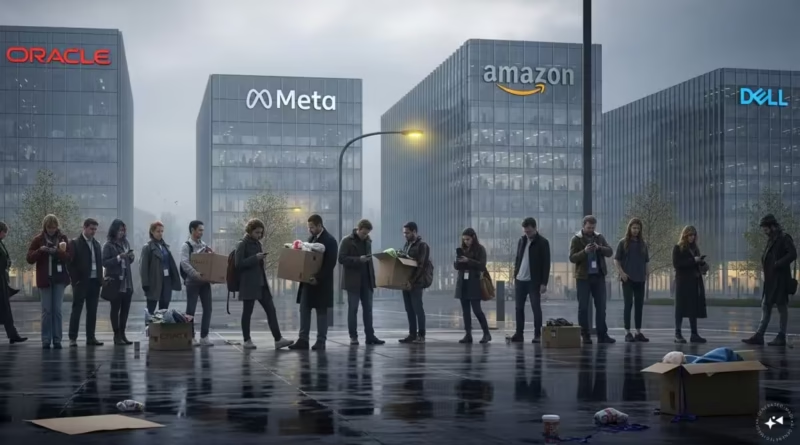
AI Boom, Human Cost: Mass Layoffs at Oracle, Snap, Block and Meta Reveal the New Reality of Tech Jobs in 2026
The first few months of 2026 have delivered a harsh wake-up call for the global workforce.
In a matter of weeks, some of the world’s biggest and most influential tech companies announced sweeping job cuts—impacting tens of thousands of employees.
What makes this wave different is not financial distress or falling revenues, but a decisive shift toward artificial intelligence.
Companies are no longer trimming costs to survive—they are restructuring to transform.
Billions of dollars are being redirected into AI infrastructure, automation tools, and next-generation systems.
And in that process, thousands of roles—many of them highly skilled—are being eliminated.
This has created a striking contrast: while stock markets continue to reward these companies, employees are facing growing uncertainty in a rapidly changing job landscape.
Oracle’s Massive Cuts: A Shock to the System
The biggest jolt came from Oracle, which reportedly laid off around 30,000 employees on March 31, including nearly 12,000 from India. The scale of the move sent shockwaves across the tech industry.
Employees learned about the decision through a formal email.
The message acknowledged their contributions but made it clear that their roles were being eliminated as part of a broader organisational shift aligned with the company’s evolving priorities—primarily its aggressive push into artificial intelligence.
For many, the experience was deeply unsettling. One day, they were part of a global tech giant; the next, they were signing termination documents and reviewing severance packages sent via email.
The tone was professional, but the impact was deeply personal—careers disrupted overnight, futures suddenly uncertain.
Snap’s Reality Check: Competing in an AI-Driven World
At Snap Inc., around 1,000 employees—roughly 16% of its workforce—were laid off. CEO Evan Spiegel explained the decision in a company memo, pointing to rapid advancements in AI as a key reason behind the restructuring.
He described the moment as a turning point for the company—caught between powerful tech giants and agile startups.
AI, he said, now allows teams to automate repetitive work and move faster, reducing the need for large workforces.
At the same time, Snap also shut down more than 300 open positions, signalling that this wasn’t just a temporary cutback but a long-term shift in hiring strategy.
For employees, the message was bittersweet.
While the company acknowledged their contributions and promised support during the transition, the underlying reality was clear: roles that once required human effort are increasingly being handled by intelligent systems.
Block’s Drastic Downsizing: “One of the Hardest Decisions”
In February, Block Inc. made one of the most dramatic moves by cutting nearly half of its workforce—over 4,000 jobs.
Co-founder Jack Dorsey was direct in his message. He clarified that the company was not struggling financially. Instead, the decision was driven by a fundamental shift toward what he called “intelligence tools”—a clear reference to AI.
Dorsey acknowledged the emotional weight of the decision, calling it one of the hardest in the company’s history.
At the same time, he outlined detailed severance support, including months of salary, healthcare benefits, equity vesting, and additional financial assistance to help employees navigate the transition.
Even with such support, the reality for thousands of workers was stark. Stable careers were suddenly replaced with uncertainty, as professionals were pushed into an already crowded and competitive job market.
Meta’s Next Move: Restructuring for the AI Era
The wave is set to continue with Meta Platforms, which is reportedly planning to cut around 10% of its workforce.
An internal memo from Chief People Officer Janelle Gale revealed that the layoffs are part of a broader restructuring linked to increased investment in AI technologies.
The company is also closing around 6,000 open roles, signalling a significant shift in hiring priorities.
The memo acknowledged the anxiety such news creates, especially when details are still unfolding.
Meta has promised severance packages, extended healthcare coverage, and career support for affected employees, along with immigration assistance where needed.
Employees are expected to receive termination notices via both work and personal email accounts—a detail that underscores how formal and system-driven the process has become.
The Bigger Picture: AI Growth vs Human Impact
Across these companies—Oracle, Snap Inc., Block Inc., and Meta Platforms—a common pattern is emerging:
- Businesses are not shrinking—they are evolving
- Investment is shifting from human labour to AI systems
- Efficiency is increasing, but job security is decreasing
For employees, this transition feels deeply personal.
Many of those affected are experienced professionals who had built stable careers, only to find themselves suddenly displaced—not because they underperformed, but because technology has changed the rules of the game.
A New Employment Reality
What’s unfolding is more than just a series of layoffs—it’s a structural shift in how companies operate. Artificial intelligence is no longer just a tool; it is becoming the backbone of decision-making, productivity, and growth.
For the workforce, this raises difficult questions:
- Which jobs will remain secure?
- How quickly must workers adapt?
- And what happens to those left behind in this transition?
As 2026 progresses, one thing is becoming increasingly clear: the AI revolution is not just transforming industries—it is redefining the very meaning of work.


