
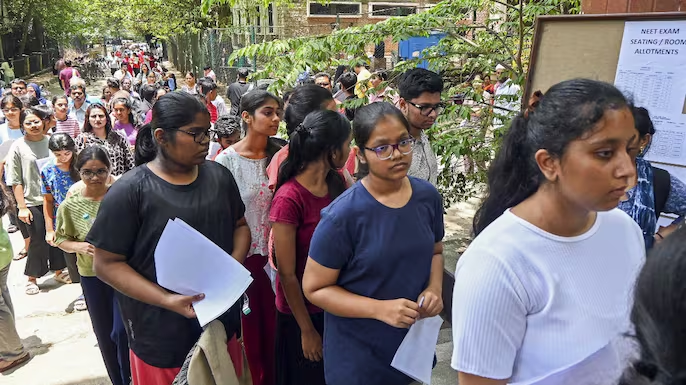
NEET Row Deepens: Why the Shift to Online Exams Has Triggered Fresh Questions Over NTA’s Credibility
Days after the controversial cancellation of the NEET-UG examination over allegations of a paper leak, the debate over how India conducts its largest entrance tests has intensified once again.
Union Education Minister Dharmendra Pradhan recently announced that from next year onward, NEET-UG will be conducted entirely as a computer-based test (CBT), marking a major shift from the traditional pen-and-paper format that has been followed for years.
The announcement was projected as a reform aimed at strengthening exam security and restoring confidence in the system after widespread outrage over alleged leaks and irregularities in this year’s medical entrance examination.
However, the move has also reopened a larger debate — whether online examinations are actually safer than offline ones, and whether the National Testing Agency is institutionally equipped to conduct high-stakes national examinations involving millions of students.
Parliamentary Panel Had Favoured Pen-and-Paper Exams
Interestingly, the Centre’s decision appears to go against recommendations made by a Parliamentary Standing Committee only last year.
In its 371st Report submitted to Parliament in 2025, the Parliamentary Standing Committee on Education, Women, Children, Youth and Sports had expressed greater confidence in the traditional pen-and-paper model.
The committee argued that several large-scale Indian examinations — including those conducted by the Central Board of Secondary Education and the Union Public Service Commission — had remained relatively secure for years despite being offline examinations.
According to the panel, the NTA should study those systems carefully and adopt similar safeguards instead of completely moving away from physical exams.
“Between the two, the Committee supported a greater focus on pen-and-paper examinations,” the report noted, while also acknowledging that no examination system is entirely foolproof.
Online Exams Bring a Different Kind of Risk
The committee did not completely reject computer-based testing. Instead, it warned that online exams come with their own vulnerabilities.
While paper-based examinations are susceptible to leaks during printing, transportation or distribution, digital examinations can potentially be hacked in ways that are difficult to detect later.
The panel therefore recommended that if CBTs are used, they should be conducted only in government-owned or government-controlled centres and not through private institutions or outsourced vendors.
This recommendation reflected growing concern about the role of private contractors in India’s entrance examination ecosystem.
NTA’s Performance Under Scrutiny
The Parliamentary Committee, headed by senior Digvijaya Singh, was sharply critical of the NTA’s recent performance.
The report stated that the agency’s functioning over the previous year had failed to inspire confidence among students and parents.
According to the committee, at least five out of the 14 major competitive examinations conducted by the NTA in 2024 faced serious disruptions or controversies.
Among the most significant issues:
- UGC-NET had to be cancelled.
- CSIR-NET was postponed.
- NEET-PG was delayed.
- NEET-UG faced allegations of paper leaks.
- CUET results were delayed repeatedly.
The committee observed that repeated disruptions were eroding public trust in the examination system.
It further pointed to problems in the JEE Main 2025 examination, where multiple questions reportedly had to be withdrawn due to errors in the final answer key.
The panel warned that such incidents create enormous anxiety among students who spend years preparing for these highly competitive exams.
Concerns Over Blacklisted Vendors and Outsourcing
One of the most serious concerns raised by the committee related to the private firms involved in conducting examinations.
The report noted that several companies engaged in paper printing, logistics, surveillance and exam administration had previously been blacklisted by certain states or organisations, yet continued receiving contracts elsewhere.
To address this, the committee recommended the creation of a nationwide blacklist database that would prevent tainted firms or individuals from securing future examination-related contracts.
The panel stressed that the Department of Higher Education must coordinate with state governments and examination agencies to maintain transparency and accountability.
The recommendation gained significance because the examination ecosystem in India increasingly depends on outsourced vendors for critical operations such as question paper printing, transportation, biometric verification, data handling and computer infrastructure.
Critics argue that excessive outsourcing weakens accountability and increases vulnerability.
NTA’s Financial Surplus Raises Questions
The committee also examined the financial functioning of the NTA and highlighted that the agency had accumulated a substantial surplus over the years.
According to the report, the NTA collected nearly ₹3,513 crore over six years while spending approximately ₹3,065 crore on examinations, creating a surplus of around ₹448 crore.
The committee recommended that this money should not remain idle and instead be used to strengthen the agency’s own capabilities.
It suggested investing in infrastructure, technological systems, internal staffing and regulatory oversight so that the NTA becomes less dependent on external vendors.
The panel also recommended that the NTA should publish detailed annual reports and audited statements before Parliament every year to improve transparency.
Delayed Results and Student Anxiety
Repeated delays in the declaration of examination results also drew criticism.
The committee specifically highlighted delays in CUET results, saying such disruptions not only postpone admissions but also affect the beginning of academic sessions across universities.
For lakhs of students and families, these delays create uncertainty regarding admissions, relocation, hostel arrangements and career planning.
The report emphasised that examination systems should prioritise predictability, transparency and mental well-being of students.
Coaching Culture and the ‘Parallel Education System’
Another major issue flagged by the committee was the rapid growth of India’s coaching industry.
The panel observed that highly competitive entrance examinations have increasingly created a “parallel curriculum” separate from school education.
Students often spend years attending expensive coaching centres instead of focusing on regular schooling, particularly in cities like Kota, which has become synonymous with entrance exam preparation.
The committee recommended that question papers should align more closely with school syllabi so that students do not feel compelled to depend heavily on coaching institutes.
It also called for the formation of a high-level committee to regulate the coaching industry and study its impact on students.
The issue has gained urgency in recent years due to rising concerns over student stress, burnout and mental health pressures associated with competitive examinations.
Tamil Nadu Panel Calls for NTA to Be Disbanded
The criticism of the NTA has not remained limited to Parliament.
A high-level committee set up by the Dravida Munnetra Kazhagam government in Tamil Nadu went even further by recommending that the NTA itself should be dismantled.
The committee, headed by retired Supreme Court judge Kurian Joseph, submitted a report earlier this year examining Centre-state relations and educational governance.
The panel argued that concentrating national entrance examinations under a single central agency had created serious structural risks.
According to the report, the NTA lacks adequate statutory backing and institutional accountability because it operates merely as a registered society rather than a constitutionally empowered independent authority.
The panel criticised the agency’s staffing structure, pointing out that it relies heavily on deputationists, contractual employees and outsourced workers despite handling some of India’s most sensitive examinations.
‘Single Point of Failure’
The Tamil Nadu panel described the NTA model as a “single-point-failure risk.”
The report argued that critical examination functions — including printing, logistics, data management, surveillance and computer systems — are fragmented across multiple contractors, creating vulnerabilities at several levels.
The panel warned that concentrating authority within one centralised body while simultaneously outsourcing operations weakens both accountability and operational security.
The committee also criticised the growing centralisation of education policy, particularly through NEET.
Tamil Nadu has long opposed NEET, arguing that it disadvantages rural, government-school and economically weaker students while undermining states’ control over admissions to institutions they themselves fund and administer.
The panel described NEET as “the most aggressive intervention in the federal educational space.”
Demand to Shift Education Back to the State List
Beyond the NTA issue, the Tamil Nadu committee made broader constitutional recommendations.
It called for education to be moved from the Concurrent List back to the State List, arguing that states should have greater autonomy in shaping educational policies and admissions.
The panel also suggested reducing regulatory control by bodies like the University Grants Commission over top institutions and ending the practice of Governors serving as Chancellors of state universities.
In another significant recommendation, it called for English to be permanently recognised as an official language of the Union through constitutional amendment.
NEET Leak Controversy Has Become a Turning Point
The latest NEET controversy appears to have become a turning point in India’s entrance examination debate.
For years, students, parents and state governments have expressed concerns about paper leaks, inconsistent exam management, technical glitches and the growing psychological burden of centralised high-stakes testing.
The alleged NEET paper leak has now transformed those concerns into a national political issue.
While the Centre believes shifting to computer-based testing will reduce leak-related risks, critics argue that digital systems are not immune to manipulation either.
Cybersecurity experts warn that hacking, remote access vulnerabilities and digital fraud can become equally dangerous if online systems are not monitored rigorously.
Larger Questions Remain Unanswered
At the heart of the debate lies a much larger question: should a single examination determine the future of millions of students across a country as diverse as India?
Supporters of centralised exams argue they create uniform standards and reduce admission irregularities.
Opponents believe they intensify inequality by favouring students with access to coaching, technology and urban educational infrastructure.
For now, the government’s decision to move NEET online marks one of the biggest changes in India’s examination system in recent years.
But whether the shift restores public confidence — or merely introduces a new set of risks — remains to be seen.


