

Hanumant Katha in Prayagraj: Dhirendra Krishna Shastri’s ‘Sundarkand’ Discourse Blends Devotion, Life Lessons and Spiritual Awakening at Arail Ghat
As the sun softened over the sacred banks of the Triveni Sangam, the air at Arail Ghat in Prayagraj carried a quiet anticipation.
By early evening, thousands had gathered—not merely to listen, but to feel, to connect, and perhaps to reflect.
When Dhirendra Krishna Shastri arrived for the second day of the three-day Hanumant Katha, the gathering transformed into a sea of devotion.
The discourse, centered around Sundarkand, unfolded not as a sermon alone but as a gentle yet powerful exploration of life itself. Beginning with a soulful rendition of Hanumanashtak,
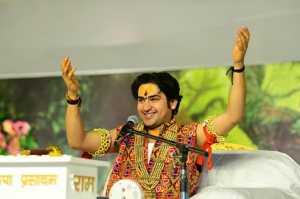
Shastri gradually drew the audience into a deeply immersive spiritual experience.
As chants of “Jai Jai Radha Raman Hari Bol” echoed through the campus, devotion seemed to ripple across the crowd—uniting strangers in a shared feeling.
But beyond the music and chants, it was his reflection on the word “व्यर्थ” (meaninglessness) that struck a chord.
He spoke of how, in the rush of modern life—whether social, political, or personal—people often lose direction, engaging in pursuits that ultimately leave them empty.
With a blend of simplicity and sharp insight, he urged people to guard their time, their thoughts, and their conduct.
His advice was direct, almost conversational—avoid gossip, distance yourself from negativity, and stay mindful of desires that derail one’s path.
“If you walk carefully, protecting your mind from distractions and negativity, you will reach your aim,” he said, inviting the audience to raise their hands in quiet commitment.
Thousands responded, their raised hands reflecting not just agreement, but a shared yearning for clarity.
Moments later, the tone softened again as he led a musical rendition of “Jeevan Maut Ka Khel Hai Pagle…”, reminding listeners of life’s fleeting nature.
The atmosphere turned contemplative, yet warm—echoing with claps, chants of “Jai Shri Ram”, and invocations of sacred places like Akshayvat and Mankameshwar.
A Day Rooted in Faith and Sacred Geography
Before the evening discourse, Shastri had spent the day immersed in the spiritual geography of Prayagraj.
At the Sangam, he took a ritual dip and performed Ganga pujan, accompanied by local religious leaders.
The journey continued to the revered Bade Hanuman Ji Temple, where he offered prayers and performed rituals with deep reverence.
Later, within the historic precincts of Allahabad Fort, he sat quietly near the sacred Akshayvat and Saraswati Koop.
Reflecting on the experience, he shared a thought that resonated deeply: that the mythical Saraswati may not be lost, but subtly present—not vanished, but absorbed into the spiritual essence of Prayagraj itself.
It was less a statement and more a feeling—one that many in the audience seemed to understand without explanation.
Confluence of Faith, Culture, and Public Life
The gathering also saw the presence of several well-known faces. Actor Gajendra Chauhan engaged the audience with a simple yet thought-provoking question—many had watched Mahabharat, but how many lived its lessons? The silence that followed spoke volumes.
Puneet Issar, reflecting on the scale of participation, described it as a sign of spiritual awakening, while actor-politician Dinesh Lal Yadav and MP Manoj Tiwari were among those who came seeking blessings.
Even Keshav Prasad Maurya spent time at the religious discourse, quietly listening before offering his respects.
Adding a broader spiritual perspective, Swami Chidanand Saraswati described the gathering as “a new kind of Sangam (Confluence)”—not just of rivers, but of faith, people, and consciousness.
Beyond an Event, A Shared Inner Journey
What unfolded at Arail Ghat was not just a religious event—it felt like a pause in the relentless pace of everyday life.
Families sat together, strangers shared space without hesitation, and for a few hours, conversations shifted from routine worries to deeper questions about purpose, conduct, and faith.
As the evening drew to a close and chants slowly faded into the night, what lingered was not just the sound—but the sentiment.
A reminder that in places like Prayagraj, spirituality is not confined to rituals alone; it lives in collective experience, in shared silence, and in the gentle search for meaning within.


