
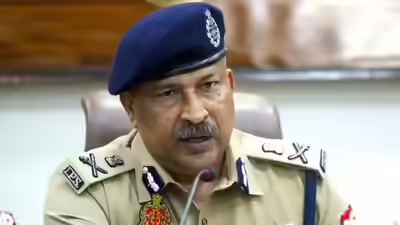
New UP DGP Rajeev Krishna Highlights 93% Conviction Rate, Tech-Driven Policing and Zero-Tolerance Crime Policy
Uttar Pradesh Director General of Police Rajeev Krishna has reaffirmed the state police force’s commitment to a strict “zero-tolerance” approach towards crime and criminal activity.
Speaking shortly after he was appointed the state’s top police officer on May 31, Krishna said the strategy has delivered strong results, with courts recording a conviction rate exceeding 93 per cent over the past year.
Sharing details of the police force’s performance, Krishna said that courts disposed of 32,071 criminal cases during the period, resulting in convictions in 29,911 cases.
Among those convicted, 18 offenders were awarded the death penalty, while 3,340 individuals received life imprisonment sentences.
The DGP also highlighted the extensive use of the Uttar Pradesh Gangsters Act against organised crime.
According to him, legal proceedings were initiated against 5,684 accused persons under the law, while assets worth approximately ₹788.38 crore were seized and attached as part of enforcement measures.
A 1991-batch Indian Police Service officer, Rajeev Krishna officially took charge as Uttar Pradesh DGP after serving as the acting police chief since May 31, 2025.
Throughout his career, he has built a reputation for strengthening border security systems and introducing administrative innovations within law enforcement agencies.
One of his most notable contributions came during his tenure as Inspector General (Operations) in the Border Security Force between 2013 and 2017.
During this period, he played a key role in conceptualising and implementing the Comprehensive Integrated Border Management System (CIBMS), an advanced surveillance framework designed to improve border protection.
The CIBMS combines a range of modern monitoring technologies, including high-tech radars, surveillance cameras, underground sensors, underwater detection systems and aerial monitoring tools.
The project significantly enhanced security arrangements in infiltration-prone border regions by creating a technology-driven monitoring network.
The importance of the system was recently underscored when Union Home Minister Amit Shah directed that the CIBMS model be expanded across all borders guarded by the Border Security Force.
Over the course of his distinguished career, Krishna has earned several prestigious honours.
These include the Police Medal for Gallantry in 2002, the Bar to Police Medal for Gallantry in 2009, the President’s Police Medal for Distinguished Service in 2015, and the Medal for Meritorious Service in 2007.
His wife, Meenakshi Singh, an officer of the Indian Revenue Service, is currently serving as the Chief Commissioner of Income Tax in Lucknow.
She has also been recognised for her professional achievements and received the Finance Minister Excellence Award for outstanding service.
Reviewing his one-year tenure as acting DGP, Krishna said he had successfully pursued and implemented the ten key priorities he outlined when he first assumed charge of the state’s police force last year.
On the issue of women’s safety, he noted that Mission Shakti centres have been established at police stations across the state.
These facilities include dedicated women’s help desks operated by female police personnel to provide assistance and support to women seeking help.
To strengthen public trust and improve citizen services, the police department has introduced a systematic mechanism for monitoring and resolving complaints more efficiently.
Krishna said ensuring prompt grievance redressal and maintaining public order remain among the department’s foremost objectives.
Addressing the growing challenge of cybercrime, the DGP highlighted the establishment of a dedicated cybercrime call centre in Lucknow.
He said police teams have successfully frozen ₹400.66 crore linked to online fraud cases, helping Uttar Pradesh secure the top position in the country for regulatory implementation in cybercrime control.
Krishna also stressed the increasing role of artificial intelligence and digital tools in modern policing.
He cited the development of the ‘Yaksh’ application, a technology platform equipped with features such as facial recognition, voice-based searches, CrimeGPT-powered analysis, gang monitoring and beat-level tracking.
According to him, the application has significantly improved crime detection and helped investigators identify and apprehend offenders.
He further said that the Uttar Pradesh Police training division has been issued updated guidelines aimed at enhancing professional development and modernising training infrastructure.
Krishna himself has previously headed the department’s training wing and remains focused on building a skilled and future-ready police force.
On the welfare front, he highlighted a landmark initiative under which Personal Accident Insurance coverage was extended to retired police personnel for the first time, providing an additional layer of financial security to pensioners.
Road safety has also remained a major area of focus. Krishna said accident-prone locations have been mapped across districts and police commissionerates, while 573 dedicated crash response teams have been deployed to reduce fatalities and improve emergency response capabilities.
Concluding his review, the DGP emphasised the importance of identifying and nurturing talent within the police force.
Officers and personnel across all ranks are being provided specialised training in cyber investigations, scientific evidence collection, forensic techniques and contemporary policing practices to ensure the force remains prepared for emerging challenges.


