
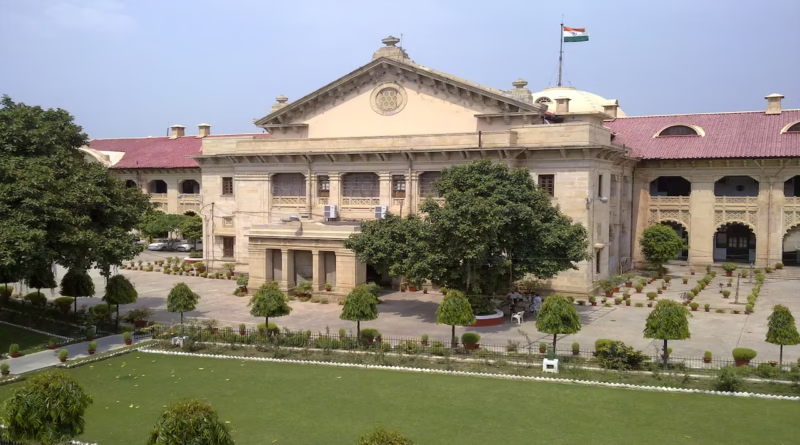
Allahabad High Court Split on NHRC Role in UP Madrasa Probe, Justice Sreedharan Questions Priorities
In a significant hearing at the Allahabad High Court, sharp differences emerged between two judges over the role of the National Human Rights Commission (NHRC) in ordering an inquiry into allegations against 558 aided madrasas in Uttar Pradesh.
The matter came up before a division bench of Justice Atul Sreedharan and Justice Vivek Saran on April 27, while hearing a petition that challenges both the NHRC’s directive and the ongoing probe by the Economic Offences Wing (EOW) in Lucknow.
Justice Sreedharan Raises Tough Questions
During the hearing, Justice Sreedharan made strong observations, questioning why the NHRC chose to intervene in this particular matter while,
In his view, failing to act on its own in more serious cases involving alleged violence against members of the Muslim community.
He remarked that it was surprising to see human rights bodies stepping into issues that could be addressed through a writ petition in the High Court, especially when there are instances of mob violence or harassment where, he said, such commissions have not taken suo motu cognisance.
In his view, institutions like the NHRC and even the State Human Rights Commission appeared to be “dabbling” in areas that did not directly fall within their primary responsibility, instead of focusing on cases involving alleged violations of fundamental rights.
Justice Sreedharan also noted that the court had not been shown any instance where these commissions had proactively intervened in cases of vigilante violence or communal harassment, raising broader concerns about their priorities.
The matter has now been listed for further hearing on May 11, 2026.
Justice Saran Disagrees With Remarks
However, Justice Vivek Saran did not agree with these observations and expressed his reservations clearly.
He pointed out that the NHRC was not even represented in court at the time these remarks were made. Moreover, the petitioner’s counsel had only sought an adjournment and was not actively arguing the case.
In such a situation, Justice Saran said, it would have been more appropriate to refrain from making strong observations about the role of the NHRC without hearing all sides.
“If any order touching upon the role of the NHRC was to be passed, all concerned parties should have been given a proper opportunity to present their case,” he observed.
He also emphasised that while courts do have the authority to pass orders even in the absence of a party, fairness demands that significant remarks — especially those affecting an institution’s functioning — be made only after proper representation.
That said, Justice Saran agreed that the request for adjournment should be allowed.
Background of the Case
The case itself stems from a petition filed by the Teachers Association Madaris Arabia.
The association has challenged an order issued by the NHRC in February 2025, which directed the Economic Offences Wing in Uttar Pradesh to investigate allegations against 558 aided madrasas.
The complaint, filed by Mohd Talha Ansari, alleged serious irregularities.
It claimed that several madrasas were operating in alleged collusion with officials from the Minority Welfare Department and were receiving government funds without meeting the required norms.
There were also accusations that unqualified teachers were being appointed, with allegations of bribes and commissions influencing recruitment processes.
What Lies Ahead
With differing views expressed within the bench itself, the case has taken on an added layer of complexity.
While the core issue remains the legality of the NHRC’s direction and the subsequent probe, the broader debate around institutional roles and responsibilities has now come into focus.
The next hearing in May is expected to bring more clarity, especially once all parties — including the NHRC — are fully heard.


