

Nilgai Menace Ravages Wheat Crops Across North India: Farmers Seek Government Action to Curb Rising Antelope Threat
By BK Singh
Growing Nilgai Threat Raises Alarm Among Farmers
Farmers across large parts of North India are once again facing severe agricultural losses as herds of nilgai, commonly known as blue bull antelope, continue to destroy standing wheat crops.
With the harvest season underway, the repeated intrusion of these animals into farmlands has heightened anxiety among cultivators who fear losing months of hard work and financial investment.
The law allows an Indian to defend his life and property.
One is allowed to even pull a trigger against an intruder in case that harm is imminent, but the Indian farmer does not understands thia legal right. Those who understand prefer to suffer rather than invite unnecessary trouble at all at the cost of his hardwork and money.
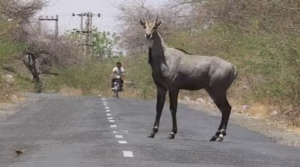
In many villages, nilgai are entering fields in groups, trampling ripe crops and feeding on wheat just days before harvesting.
While favourable weather has enabled some small farmers to complete cutting and threshing operations, those with larger landholdings report significant losses as the animals continue to raid fields both during daytime and nighttime.
These animals destroy more than what they consume. More than a bigha crop vanishes in just a night by no more than six Neelgai.
Farmers Ramsurat and Jeetlal said that despite investing considerable time and resources in cultivating their crop, large portions of their wheat fields have been damaged before harvesting could even begin.
According to them, months of effort are being wiped out within a short span as nilgai move freely across agricultural land without any effective deterrent.
Decades-Old Problem Affecting Multiple States
The menace of nilgai damaging crops has persisted for decades across several states, including Uttar Pradesh, Madhya Pradesh, Rajasthan, and Bihar.
Farmers say the animal frequently targets wheat, pulses, mustard, vegetables, and other standing crops, causing losses worth crores of rupees each year.
One of the major concerns repeatedly highlighted by cultivators is the widespread misconception regarding the animal’s identity.
 Although the term “nilgai” literally translates to “blue cow,” official government records and wildlife experts classify it as an antelope species.
A Uttar Pradesh government notification issued in the 1970s also clearly categorised nilgai as an antelope, yet awareness regarding this distinction remains limited.
Farmers believe that the continued association of the animal with cattle has created hesitation in taking firm measures to protect crops, resulting in unchecked growth of the nilgai population in several regions.
Need for Greater Awareness and Institutional Response
Experts and residents feel that the forest department should play a more proactive role in creating awareness that nilgai is not a cow but a wild antelope.
Many farmers argue that wider public awareness could help remove hesitation and encourage lawful and regulated action where required.
In addition to crop damage, nilgai also pose risks on highways and rural roads. Due to their large size and strong build, collisions between vehicles and nilgai have led to serious road accidents in several areas.
Motorists, particularly two-wheeler riders, face danger when the animals suddenly cross roads or leap into roadside vegetation after impact.
Nilgai are herbivores with high feeding capacity and are known to consume large quantities of crops and vegetation.
Their strong physical structure allows them to move quickly across fields, often making it difficult for farmers to prevent damage once the animals enter farmland.
Legal Procedure Exists, but Farmers Call for Simplification
Existing administrative procedures allow affected farmers to submit applications to district authorities seeking permission for action to prevent nilgai-related crop damage.
Following administrative approval, farmers are required to approach the concerned police station before taking any further lawful measures.
However, farmers say the process is time-consuming and often impractical during peak harvesting periods when immediate action is required.
Many cultivators believe that simplifying the procedure and introducing preventive mechanisms would significantly reduce losses.
Economic Impact and Rising Farmer Concerns
Agricultural losses caused by nilgai are estimated to run into crores of rupees annually across northern and central India. With limited natural predators in many regions, the population of the species has steadily increased, further intensifying the problem.
Farmers also express concerns regarding personal safety, as nilgai are large and powerful animals that can behave unpredictably when confronted. This makes it risky for individuals to attempt to drive them away without proper support or equipment.
Demand for Policy Intervention and Practical Solutions
Farmers and agricultural groups are increasingly calling for comprehensive policy measures to address the issue.
Suggested solutions include financial assistance for protective fencing, compensation for crop losses, scientific population management strategies, and faster administrative clearances for preventive action.
Many cultivators believe that unless timely and practical steps are taken, the continuing destruction caused by nilgai will remain a major challenge for agricultural communities across multiple states.
As harvesting continues, farmers remain hopeful that stronger coordination between the forest department, administration, and policymakers will help provide long-term relief and ensure better protection for standing crops.


