
Netanyahu Orders Expansion of Israeli Control in Gaza to 70%, Raising Fresh Concerns Over Ceasefire Future
Israeli Prime Minister Benjamin Netanyahu has directed the country’s military to expand its control over 70 per cent of the Gaza Strip, a move that has sparked renewed debate over the future of the fragile ceasefire agreement between Israel and Hamas.
Speaking in Hebrew during an event organised by the Ein Prat Leadership Academy in an Israeli settlement in the occupied West Bank, Netanyahu said Israeli forces currently control around 60 per cent of Gaza and have been instructed to push that figure further.
According to reports carried by Israeli media outlets, the prime minister stated that the military’s next objective would be securing control over 70 per cent of the territory.
During the event, a participant reportedly called for Israel to take complete control of Gaza.
Responding to the remark, Netanyahu said the expansion would happen in stages, adding that the immediate goal was to reach 70 per cent control before considering any further steps.
The comments come just days after Netanyahu publicly claimed that Israeli forces had already established control over roughly 60 per cent of Gaza.
His latest remarks indicate that Israel is continuing to pursue a broader military strategy despite the ceasefire framework negotiated last year.
Ceasefire Agreement Faces Growing Strain
The directive appears to be at odds with key provisions of the US-mediated ceasefire agreement reached between Israel and Hamas in October.
Under the terms of that arrangement, Israeli troops were expected to pull back behind a designated security boundary known as the “Yellow Line,” which would have limited Israel’s military presence to a significantly smaller portion of the enclave, reports Reuters.
The first phase of the agreement led to the return of hostages held in Gaza in exchange for Palestinian prisoners detained by Israel.
While that stage was implemented, the next phase of negotiations has remained stalled for months.
The unresolved second phase was expected to address some of the most difficult issues in the conflict, including the disarmament of Hamas, long-term governance arrangements inside Gaza and the withdrawal of Israeli troops.
However, talks have repeatedly hit roadblocks, preventing any meaningful breakthrough.
Latest Developments
Recent reports indicate that Israeli forces now effectively control more than 60 per cent of Gaza, compared to the approximately 53 per cent that was envisaged under the ceasefire map.
International media reports suggest that military positions and security barriers have gradually been pushed deeper into territory previously administered by Hamas.
The expansion has intensified concerns among humanitarian organisations and international observers, who warn that further territorial control could worsen conditions for Gaza’s civilian population.
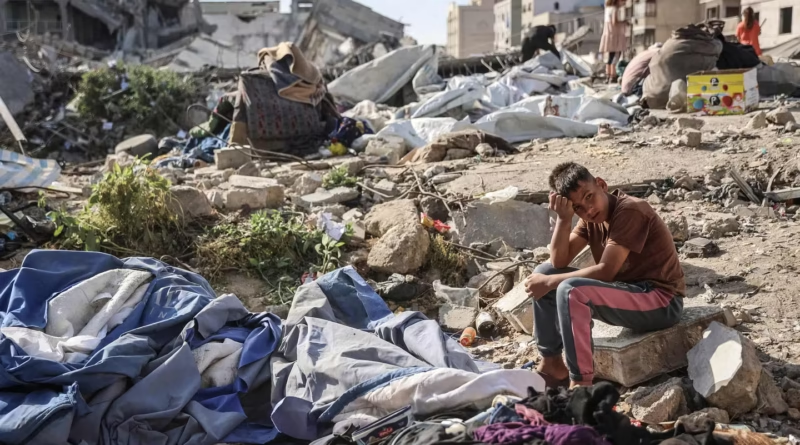
Much of the enclave has already suffered extensive destruction after nearly three years of conflict, leaving large numbers of residents displaced and dependent on humanitarian aid, according to the Guardian.
Reports also indicate that hundreds of Palestinians have been killed in military operations and airstrikes since the ceasefire took effect, even as negotiations continue behind the scenes.
Israeli officials maintain that the operations are necessary to prevent Hamas from rebuilding its military capabilities and to establish security buffer zones near Israel’s borders.
Background: How the Conflict Reached This Stage
The current war began after Hamas launched its unprecedented attack on southern Israel on October 7, 2023, killing civilians and taking hostages.
Israel responded with a large-scale military campaign in Gaza aimed at dismantling Hamas’ military and political infrastructure.
Over the course of the conflict, vast areas of Gaza were devastated, and repeated international efforts were made to broker pauses in fighting.
The October ceasefire agreement was seen as one of the most significant diplomatic achievements since the war began, creating hopes for a longer-term settlement.
However, disagreements over Hamas’ future role in Gaza, hostage releases, Israeli military withdrawals and post-war governance have prevented the ceasefire from evolving into a permanent peace arrangement.
As a result, military activity has continued despite the formal truce remaining in place, according the Reuters.
What Happens Next?
Netanyahu’s latest directive signals that Israel may continue expanding its footprint inside Gaza unless a broader political agreement is reached.
The move is likely to face scrutiny from international mediators and governments that supported the ceasefire process.
With negotiations still deadlocked and both sides maintaining firm positions on key issues, the future of the ceasefire remains uncertain.
The coming weeks could prove critical in determining whether diplomatic efforts can revive the peace process or whether the conflict enters another phase of escalation.


